
Imagine sending someone a presentation after weeks of preparation, finishing a dinner with friends, publishing a blog post, or sharing a video online. You may want to know whether the other person had a positive experience, but you do not want to sound demanding or ask directly, “Did you like it?” That is where “Hope you enjoyed” naturally fits into everyday English.
However, the best wording depends on the situation. “Hope you enjoyed” can sound warm and conversational. At the same time, alternatives such as “I trust you found it useful” or “I hope you had a pleasant experience” may be better suited to professional communication. Understanding these differences helps professionals, students, ESL learners, and content writers choose language that sounds natural rather than forced.
What Does “Hope You Enjoyed” Mean?
“Hope you enjoyed” means that the speaker wishes the other person had a pleasant, satisfying, or positive experience. The phrase usually refers to something that has already happened, such as an event, meal, presentation, trip, article, or activity. It is commonly used in conversations, emails, messages, social media posts, and closing remarks.
The complete form is often “I hope you enjoyed it”, “I hope you enjoyed the event,” or “I hope you enjoyed your meal.” In casual English, the subject “I” is frequently omitted, making “Hope you enjoyed” sound lighter and more conversational.
The phrase does not necessarily ask for detailed feedback. Instead, it expresses goodwill and leaves space for the other person to respond naturally.
Origin & History of “Hope You Enjoyed”

The phrase “hope you enjoyed” does not have a single documented inventor, famous quotation, or specific historical event behind it. It is a straightforward combination of two common English elements: “hope,” which expresses a desired outcome, and “enjoyed,” the past tense of “enjoy,” which refers to experiencing pleasure or satisfaction.
The word hope has very old Germanic roots and has been part of English vocabulary for centuries. Enjoy entered English through French and ultimately traces back to Latin roots associated with taking pleasure or benefit from something.
As English communication became increasingly informal, especially in letters, conversation, advertising, customer service, and digital messaging, shortened expressions became more common. “Hope you enjoyed” is an example of this conversational economy. The subject “I” can be omitted because the intended meaning remains obvious.
Today, the phrase is especially common in emails, event follow-ups, blogs, videos, presentations, hospitality, marketing, and social media. Its continued popularity comes from its simplicity and positive emotional tone.
When Should You Use “Hope You Enjoyed”?
“Hope you enjoyed” works best when you want to acknowledge someone’s experience in a warm and uncomplicated way.
Professional Settings
You can use it in a professional environment when the relationship is reasonably friendly.
For example:
“Thanks for joining the workshop. Hope you enjoyed the session.”
For a highly formal client or executive communication, a slightly more polished alternative may be preferable:
“I hope you found the session valuable.”
Casual Conversations
This is one of the phrase’s strongest uses. Friends, classmates, family members, and acquaintances can use it without sounding overly formal.
“Hope you enjoyed the concert!”
Writing, Presentations, and Digital Communication
The phrase works particularly well at the end of:
- Blog posts
- Videos
- Presentations
- Newsletters
- Online courses
- Social media posts
- Event messages
- Personal emails
For example:
“Thanks for reading, and I hope you enjoyed the article.”
When It Is Especially Effective
It is particularly effective when you want to close a positive interaction without demanding feedback. It sounds friendly while leaving the recipient free to respond with their own opinion.
When Should You Avoid “Hope You Enjoyed”?
Although natural, the phrase is not appropriate for every situation.
Overly Formal Situations
In legal, executive, academic, or highly formal correspondence, “Hope you enjoyed” may sound too casual.
Instead, consider:
“I hope you found the information useful.”
Legal, Academic, or Sensitive Contexts
When precision matters, the phrase may be too vague.
For example, after delivering a serious academic report, saying:
“Hope you enjoyed it.”
could sound inappropriate because the purpose of the document is more important than enjoyment.
Situations Where Nuance May Be Lost
If you need genuine feedback, the phrase may not be enough.
Instead of:
“Hope you enjoyed the workshop.”
You could say:
“I hope you found the workshop useful. We would appreciate any feedback you may have.”
This separates goodwill from feedback collection.
Real-Life Examples of “Hope You Enjoyed” by Context

Emails
“Thanks again for attending the training session. Hope you enjoyed it and found the examples useful.”
Meetings
“Thanks for taking the time to join us today. Hope you enjoyed the discussion.”
Presentations
“That brings us to the end of the presentation. Hope you enjoyed the session.”
Conversations
“You went to the new restaurant last night? Hope you enjoyed it!”
Social Media
“Thanks for watching the video! Hope you enjoyed it as much as I enjoyed making it.”
“Hope You Enjoyed” vs Similar Expressions
The alternatives below are close in meaning, but they are not completely interchangeable. Small differences in formality, warmth, certainty, and purpose can change how a sentence feels.
| Phrase | Meaning Difference | Tone Difference | Best Use Scenario |
| I hope you enjoyed it | Expresses a wish that someone had a positive experience | Neutral and polite | General emails and conversations |
| I hope you had a good time | Focuses more directly on enjoyment | Warm and friendly | Events, trips, parties |
| I hope you liked it | Focuses on whether someone personally liked something | Casual and direct | Shared content, gifts, meals |
| I trust you enjoyed it | Shows greater confidence that the experience was positive | More formal | Business correspondence |
| I hope you found it useful | Focuses on practical value rather than pleasure | Professional | Training, articles, presentations |
| I hope you had a pleasant experience | Emphasizes overall satisfaction | Polite and formal | Customer service and professional settings |
“Hope You Enjoyed” in Digital & Modern Communication

Emails
The phrase works well as a friendly closing after a webinar, training session, presentation, or shared resource.
Slack / WhatsApp
Its short form is particularly natural in quick messages:
“Hope you enjoyed the event!”
Social Media
Creators frequently use it after sharing videos, photographs, stories, recipes, or personal experiences.
AI-Generated Summaries
AI-generated content can sometimes overuse phrases such as “Hope you enjoyed” because they are common polite closings. Human editors should check whether the expression genuinely fits the context rather than adding it automatically.
Linguistic & Communication Insight
Emotional Weight & Subtext
The literal meaning is simple, but native speakers can perceive a small amount of social warmth behind the phrase. The speaker is not merely reporting information; they are signaling that the recipient’s experience matters.
However, the emotional weight is relatively light. “Hope you enjoyed” does not normally communicate deep concern, strong affection, urgency, or serious emotional investment.
Direct vs Indirect Phrasing
The phrase is indirect because it does not ask:
“Did you enjoy it?”
Instead, it states a hope:
“Hope you enjoyed it.”
This reduces pressure. The recipient can simply agree, disagree, explain their experience, or move on.
A more direct question is useful when feedback is needed. A softer statement is better when the goal is simply to close an interaction politely.
Professional Communication Perspective
In workplace communication, the phrase can humanize a message, particularly after an informal meeting, workshop, event, or team activity.
For a formal report or client communication, “I hope you found this information useful” may communicate the professional purpose more accurately.
Pragmatic Reasons for Alternatives
Experienced communicators often choose alternatives based on what they want the recipient to focus on.
- Enjoyment emphasizes personal experience.
- Usefulness emphasizes practical value.
- A good time emphasizes pleasure and social experience.
- A pleasant experience emphasizes overall satisfaction.
- Worthwhile emphasizes value or benefit.
- Liked it emphasizes personal preference.
Choosing the right expression therefore makes the message more precise without making it longer.
Social Signaling
Word choice influences how people perceive the speaker. A warm expression can signal friendliness, while a formal expression can signal professionalism and distance.
The best choice is not always the most formal one. Good communication matches the language to the relationship and purpose.
Tone & Context Guidance
Use “Hope you enjoyed” when the experience was reasonably positive, and the setting is conversational. Be more careful when discussing serious subjects, formal decisions, complaints, academic work, or sensitive events.
10 best alternatives explanation:
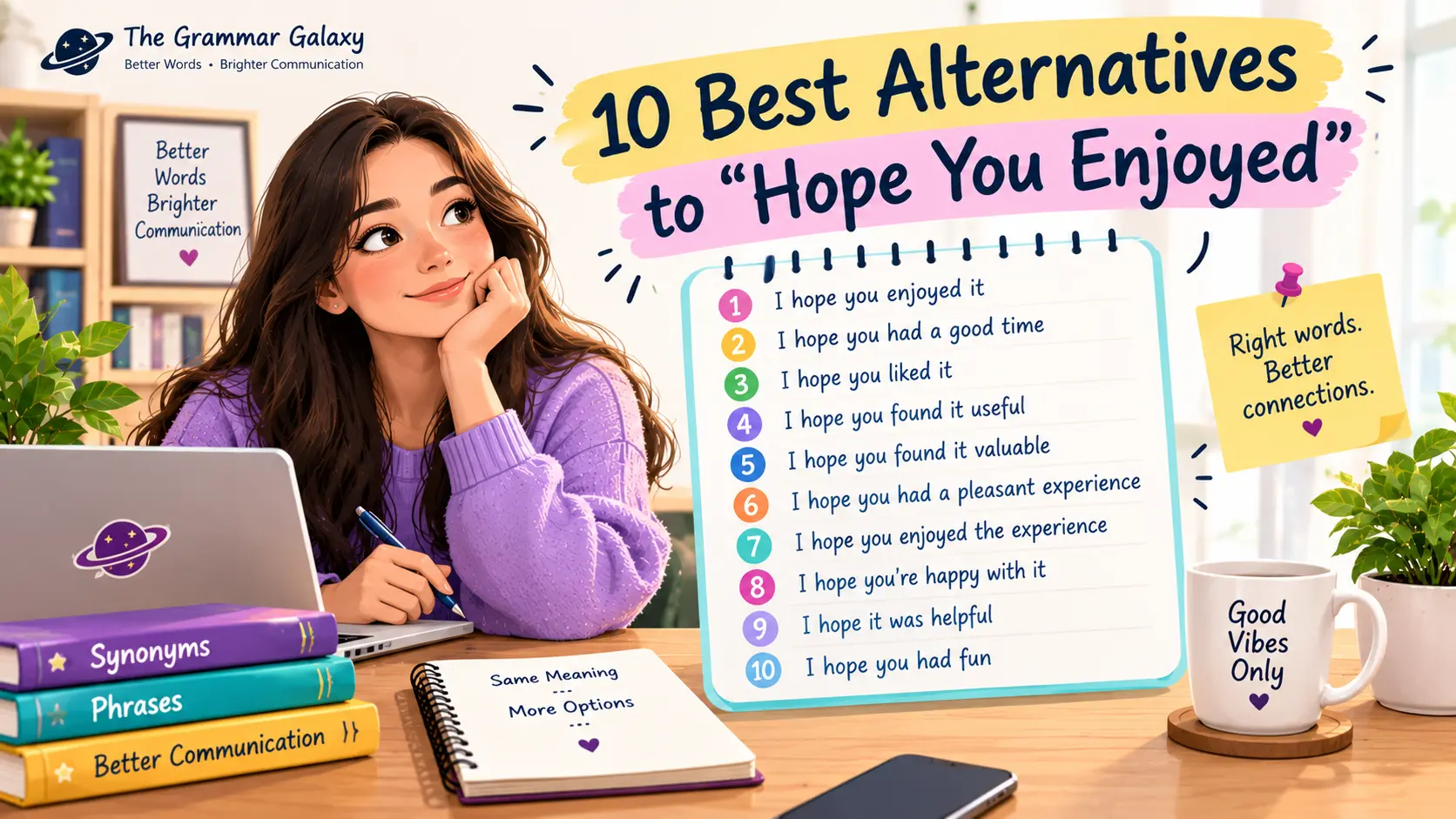
I Hope You Enjoyed It
Meaning: This is the complete version of the shortened expression “Hope you enjoyed.” It communicates a wish that the recipient had a positive experience with something that has already happened.
Why This Phrase Works: Adding “I” makes the sentence grammatically complete while preserving its friendly character. It is slightly more polished than the shortened version without becoming stiff.
Real-World Usage Insight: This is one of the safest general-purpose alternatives because it works across many situations without sounding excessively formal.
Best Use: Emails, presentations, events, shared content, workshops, and everyday conversations.
Avoid When: The subject is serious, negative, or unrelated to personal enjoyment.
Tone: Friendly, polite, neutral, conversational.
US vs UK Usage: Common and natural in both American and British English.
Example (Email / Message / Meeting): “Thanks for joining the workshop today. I hope you enjoyed it and found the discussion helpful.”
I Hope You Liked It
Meaning: This expression asks indirectly whether someone had a favorable opinion of something they experienced, received, watched, ate, or read.
Why This Phrase Works: “Liked” is more focused on personal preference than “enjoyed,” so it works particularly well when the speaker wants an opinion.
Real-World Usage Insight: It sounds very natural when someone has given another person a gift, prepared food, shared a creative project, or recommended something.
Best Use: Gifts, meals, films, articles, creative work, and recommendations.
Avoid When: You need formal feedback or an objective evaluation.
Tone: Casual, warm, direct.
US vs UK Usage: Natural in both American and British English.
Example (Email / Message / Meeting): “I finally sent over the article draft. I hope you liked it.”
Hope You Had Fun
Meaning: This phrase expresses a wish that someone enjoyed themselves during an activity or event.
Why This Phrase Works: “Fun” is simple, emotionally positive, and strongly associated with informal experiences.
Real-World Usage Insight: It sounds especially natural when talking about children, parties, vacations, games, outings, or recreational activities.
Best Use: Informal events, trips, parties, entertainment, and friendly messages.
Avoid When: Writing formal business correspondence or discussing serious professional matters.
Tone: Casual, upbeat, friendly.
US vs UK Usage: Common in both, with no major meaning difference.
Example (Email / Message / Meeting): “Hope you had fun at the team outing yesterday!”
I Trust You Enjoyed It
Meaning: This phrase indicates that the speaker confidently expects the recipient to have had a positive experience.
Why This Phrase Works: “Trust” creates a stronger sense of confidence than “hope,” making the expression more formal and business-oriented.
Real-World Usage Insight: It can work well in polished correspondence, although it may sound slightly old-fashioned or formal in casual conversation.
Best Use: Formal emails, business correspondence, hospitality, and professional follow-ups.
Avoid When: Messaging close friends or writing very casual communication.
Tone: Formal, polite, confident.
US vs UK Usage: Understood in both, although it may sound somewhat more formal in everyday American conversation.
Example (Email / Message / Meeting): “Thank you for attending the conference. I trust you enjoyed the program and found the sessions informative.”
Example (Email / Message / Meeting): “I’ve attached the revised guide. I hope you found it useful when preparing the proposal.”
I Hope You Found It Worthwhile
Meaning: This phrase expresses a wish that the recipient considered the experience valuable enough to justify their time or effort.
Why This Phrase Works: It recognizes that the recipient invested something, usually time, attention, or money.
Real-World Usage Insight: It is particularly useful after conferences, workshops, courses, consultations, or professional events.
Best Use: Training, conferences, courses, workshops, meetings, and business events.
Avoid When: Talking about very casual entertainment where “worthwhile” may sound unnecessarily serious.
Tone: Professional, thoughtful, moderately formal.
US vs UK Usage: Used naturally in both American and British English.
Example (Email / Message / Meeting): “Thank you for staying through the final session. I hope you found the workshop worthwhile.”
I Hope You Enjoyed the Experience
Meaning: This phrase refers to someone’s overall experience rather than one specific part of an activity.
Why This Phrase Works: The word “experience” makes the expression broad enough for travel, hospitality, education, services, events, and professional interactions.
Real-World Usage Insight: Businesses frequently use this wording because it sounds attentive without being excessively informal.
Best Use: Customer service, hotels, events, courses, travel, and professional follow-ups.
Avoid When: A simple informal phrase would be more natural between close friends.
Tone: Polite, professional, considerate.
US vs UK Usage: Widely understood and used in both.
Example (Email / Message / Meeting): “Thank you for visiting our office. I hope you enjoyed the experience and found the team welcoming.”
Glad You Had a Chance to Enjoy It
Meaning: This phrase communicates happiness that someone had an opportunity to experience something enjoyable.
Why This Phrase Works: It acknowledges both the opportunity and the person’s enjoyment.
Real-World Usage Insight: It can sound especially thoughtful when someone has been busy or when an enjoyable activity was not guaranteed.
Best Use: Personal messages, workplace conversations, trips, events, and informal follow-ups.
Avoid When: You need a short, highly formal business closing.
Tone: Warm, supportive, conversational.
US vs UK Usage: Natural in both varieties.
Example (Email / Message / Meeting): “I know the schedule was packed, so I’m glad you had a chance to enjoy the dinner afterward.”
Hope You Got Something Out of It
Meaning: This expression means the speaker hopes the recipient gained some benefit, insight, enjoyment, or useful experience.
Why This Phrase Works: It is flexible and can refer to practical, educational, or personal value without specifying exactly what the benefit should be.
Real-World Usage Insight: It is common in informal professional conversations, especially after workshops, talks, discussions, or shared resources.
Best Use: Workshops, meetings, classes, discussions, talks, and informal feedback.
Avoid When: Writing highly formal client correspondence.
Tone: Conversational, encouraging, informal.
US vs UK Usage: Common in both American and British English.
Example (Email / Message / Meeting): “Thanks for staying until the end of the webinar. Hope you got something out of it.”
I Hope You Had a Pleasant Experience
Meaning: This phrase expresses a wish that someone’s overall interaction with a service, organization, event, or activity was comfortable and satisfactory.
Why This Phrase Works: “Pleasant experience” sounds more polished and professional than “had fun” or “enjoyed it.”
Real-World Usage Insight: This wording is particularly common in hospitality, customer service, healthcare administration, travel, and formal business communication.
Best Use: Customer emails, hotels, services, appointments, travel, and formal follow-ups.
Avoid When: Talking casually with close friends, where it may sound overly formal.
Tone: Polite, formal, courteous.
US vs UK Usage: Natural in both varieties.
Example (Email / Message / Meeting): “Thank you for choosing our service. I hope you had a pleasant experience and received everything you needed.”
Hope It Was to Your Liking
Meaning: This phrase means the speaker hopes something matched the recipient’s preferences or expectations.
Why This Phrase Works: It focuses on personal satisfaction without directly asking whether the person liked something.
Real-World Usage Insight: It can sound polished but somewhat traditional, so it should be used selectively in modern everyday writing.
Best Use: Hospitality, formal service communication, carefully worded correspondence, and certain literary contexts.
Avoid When: Writing casual messages where a simpler expression would sound more natural.
Tone: Polite, formal, slightly traditional.
US vs UK Usage: Understood in both, but it can feel more formal or old-fashioned than other alternatives.
Example (Email / Message / Meeting): “The revised arrangements are now in place. I hope everything was to your liking.”
Comparison Table of 10 Best Alternatives
These ten alternatives cover the most useful situations, from casual conversations to professional emails. The best choice depends on whether you want to emphasize enjoyment, usefulness, value, satisfaction, or personal preference.
| Phrase | Meaning | Best Use | Worst Use | Tone | US vs UK Usage |
| I hope you enjoyed it | Wishes someone had a positive experience | General communication | Serious situations | Friendly, neutral | Common in both |
| I hope you had a good time | Wishes someone enjoyed an event or activity | Parties, trips, events | Formal reports | Warm, casual | Common in both |
| I hope you liked it | Focuses on personal preference | Gifts, food, creative work | Formal business evaluation | Casual | Common in both |
| Glad you enjoyed it | Shows pleasure that someone enjoyed something | Replies and conversations | Before knowing their reaction | Warm | Common in both |
| Hope you had fun | Wishes someone enjoyed themselves | Informal events | Formal correspondence | Casual, upbeat | Common in both |
| I trust you enjoyed it | Assumes a positive experience with confidence | Formal business communication | Close-friend messages | Formal | More formal in everyday use |
| I hope you found it useful | Focuses on practical benefit | Education and business | Pure entertainment | Professional | Common in both |
| I hope you found it worthwhile | Emphasizes value for time or effort | Courses and workshops | Casual parties | Thoughtful, professional | Common in both |
| I hope you had a pleasant experience | Focuses on overall satisfaction | Customer service | Casual chats | Polite, formal | Common in both |
| I’m glad you enjoyed it | States happiness about someone’s positive reaction | Replies to feedback | Before receiving feedback | Warm, appreciative | Common in both |
Conclusion :
“Hope You Enjoyed” is a friendly expression used after an event, meal, presentation, article, video, or other experience. The best alternative depends on the context and audience. For example, “I hope you enjoyed it” is natural and versatile, while “I hope you found it useful” suits educational and professional content.
Choosing the right wording makes your communication more natural and effective. Consider your audience, tone, and purpose before selecting an alternative to ensure your message feels appropriate, clear, and thoughtful.
FAQs :
[faq_accordion]What does “Hope You Enjoyed” mean?
It means wishing someone had a pleasant experience with an event, meal, trip, article, or activity. The complete form is “I hope you enjoyed it.”
Is “Hope You Enjoyed” grammatically correct?
Yes, it is acceptable in informal English as a shortened form of “I hope you enjoyed it.” The complete sentence is better for formal writing.
Is “Hope You Enjoyed” professional?
Yes, in friendly workplace communication. For a more professional tone, use “I hope you found it useful” or “I hope you found it valuable.”
What is another way to say “Hope You Enjoyed”?
Alternatives include “I hope you liked it,” “I hope you had a good time,” and “I hope you found it useful.”
What is the difference between “Hope You Enjoyed” and “Hope You Had Fun”?
“Hope You Enjoyed” suits many experiences, while “Hope You Had Fun” is more casual and often used for social activities and entertainment.
Can I use “Hope You Enjoyed” in an email?
Yes, it works well in friendly emails after events, presentations, or workshops. For formal emails, use “I hope you enjoyed it.”
Is “Hope You Enjoyed” formal or informal?
It is generally informal to neutral. The complete form, “I hope you enjoyed it,” sounds more polished in professional communication.
What is the difference between “Hope You Enjoyed” and “I Hope You Liked It”?
“Hope You Enjoyed” emphasizes the overall experience, while “I Hope You Liked It” focuses more on personal preference or approval.
What is the best professional alternative to “Hope You Enjoyed”?
“I hope you found it useful” is ideal for professional content, while “I hope you found it valuable” emphasizes the benefits or value of an experience.
[/faq_accordion]