
When something needs to be simple, “No Fuss, No Muss” is a friendly expression that communicates ease, convenience, and freedom from unnecessary trouble.
This informal phrase is commonly used in everyday conversations, workplace messages, customer service, and digital communication. However, choosing the right alternative can make your writing sound more natural and better suited to different situations.
What Does “No Fuss, No Muss” Mean?
“No Fuss, No Muss” means something can be done easily without unnecessary trouble, complications, or inconvenience.
“Fuss” refers to unnecessary concern or commotion, while “muss” means disorder or untidiness. Together, they emphasize simplicity and convenience.
5 Best Alternatives to “No Fuss, No Muss”
| Alternative | Situation |
|---|---|
| Straightforward | Professional emails and instructions |
| No Hassle | Customer service and casual conversations |
| Uncomplicated | Reports and formal communication |
| Simple and Easy | Tutorials and everyday explanations |
| Smooth Sailing | Friendly conversations and informal updates |
Test Your Knowledge: No Fuss, No Muss
Think you understand the phrase and its alternatives? Take this quick quiz and see how well you know them!
Quiz Completed!
Origin & History of “No Fuss, No Muss”
The expression combines “fuss,” meaning unnecessary commotion, and “muss,” meaning disorder or untidiness. The paired expression appeared in American advertisements and political writing during the late nineteenth and early twentieth centuries. Its catchy rhyme helped it become a familiar informal expression for describing simple and convenient experiences.
Synonyms & Alternatives by Tone
Professional & Neutral Alternatives
- Straightforward
- Uncomplicated
- Simple and efficient
- Without complications
- Easy to manage
- Streamlined
- Efficient and simple
Polite & Supportive Alternatives
- Easy to handle
- Simple to arrange
- Nothing complicated
- A smooth process
- Easy to work through
- Convenient and straightforward
Encouraging & Reassuring Alternatives
- You’ll find it easy
- It’s simple to get started
- Everything is straightforward
- There’s nothing to worry about
- It should be easy to manage
- The process is simple
Casual & Playful Alternatives
- No hassle
- No problem
- Easy-peasy
- Nice and easy
- No big deal
- Keep it simple
- Smooth sailing
When Should You Use “No Fuss, No Muss”?
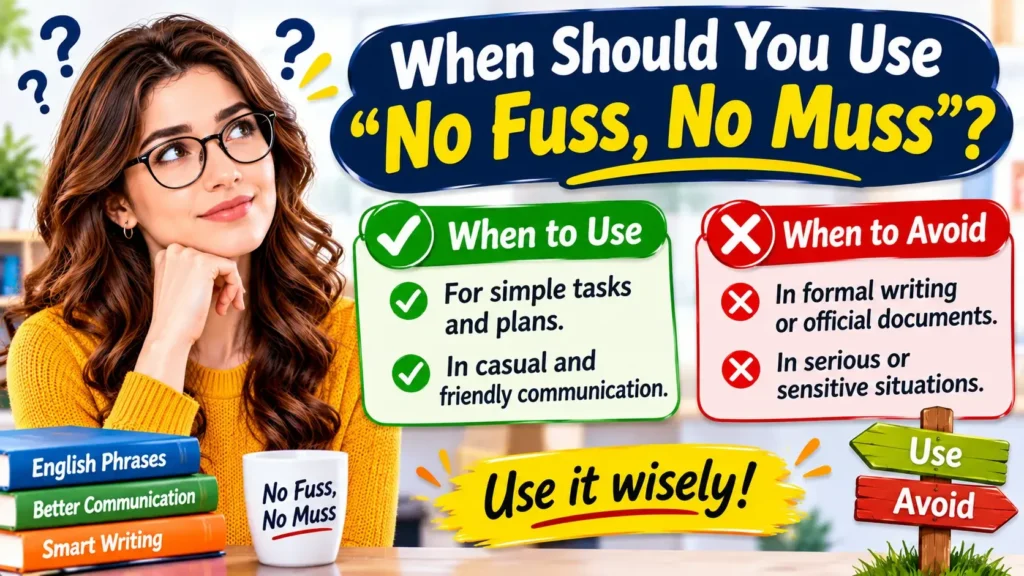
The phrase works best when you want to describe something simple, convenient, and free from unnecessary complications.
Casual Conversations
Use it with friends, family, and acquaintances when discussing easy plans, everyday tasks, or simple arrangements.
Example: “Let’s order dinner tonight. No fuss, no muss.”
Informal Workplace Communication
It is suitable for friendly workplace messages, team discussions, and simple instructions when the communication style is relaxed.
Example: “Just complete the form and submit it—no fuss, no muss.”
When Should You Avoid “No Fuss, No Muss”?
Although friendly and familiar, “No Fuss, No Muss” may not suit every communication style or situation.
Formal Writing
Use complete and professional wording instead of this informal expression in official emails, academic papers, legal documents, and business reports.
Serious Situations
Avoid using the phrase when discussing complicated problems, sensitive matters, or serious complaints, as it may make the situation sound less important than it is.
Is “No Fuss, No Muss” Professional, Polite, or Casual?
“No Fuss, No Muss” is primarily a casual and informal expression. It is generally friendly rather than rude, making it suitable for everyday conversations and relaxed workplace communication.
For formal situations, alternatives such as “straightforward,” “uncomplicated,” and “streamlined” sound more professional.
Pros and Cons of Using “No Fuss, No Muss”
Advantages
- Clarity: Communicates simplicity quickly.
- Memorability: Its rhyme makes it easy to remember.
- Friendly Tone: Makes casual communication approachable.
Potential Drawbacks
- Informality: May sound unsuitable in official writing.
- Oversimplification: Can make complicated tasks sound too easy.
- Context Sensitivity: May seem dismissive in serious situations.
Real-Life Examples of “No Fuss, No Muss” by Context
“The form only requires your signature and email address—no fuss, no muss.”
Meeting
“We can complete the approval today without unnecessary steps. No fuss, no muss.”
Presentation
“Our goal is to create a no-fuss, no-muss onboarding process for new employees.”
Casual Conversation
“Let’s stay home, order pizza, and watch a movie. No fuss, no muss.”
Social Media
“Quick breakfast, minimal cleanup, and a fresh start to the day. No fuss, no muss.”
“No Fuss, No Muss” vs Similar Expressions
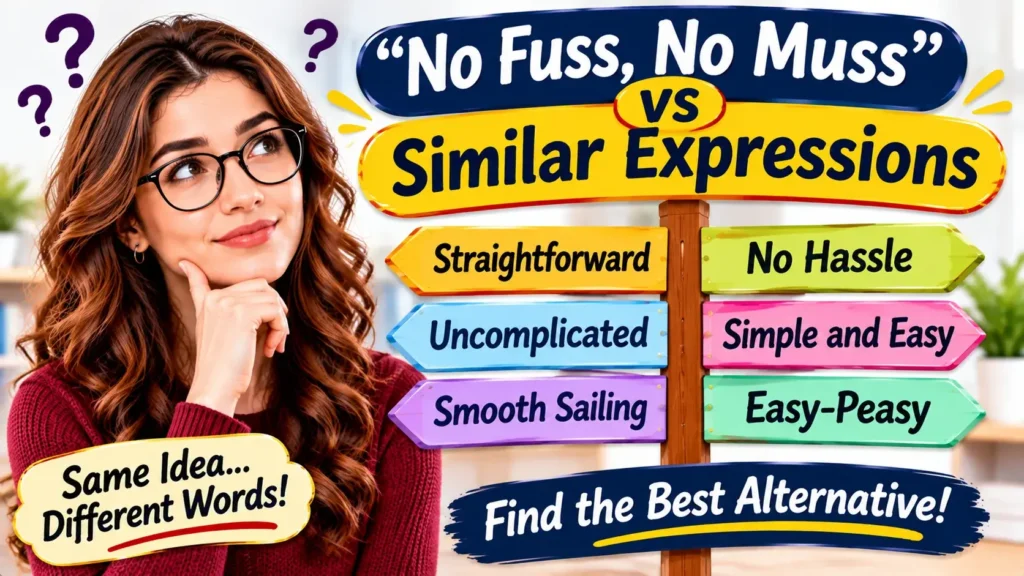
These expressions share the idea of simplicity but differ in tone and meaning.
| Phrase | Meaning Difference | Tone | Best Use |
|---|---|---|---|
| Straightforward | Easy to understand or complete | Professional | Reports and instructions |
| No Hassle | Free from inconvenience | Casual | Shopping and services |
| Uncomplicated | Without complexity | Neutral | Professional writing |
| Simple and Easy | Requires little effort | Friendly | Tutorials and explanations |
| Smooth Sailing | Progress without major difficulty | Casual | Everyday updates |
| Easy-Peasy | Extremely easy | Playful | Friendly conversations |
Key Differences in Meaning
“Straightforward” is a reliable professional alternative, while “no hassle” emphasizes convenience. “Uncomplicated” focuses on simplicity, whereas “smooth sailing” suggests continued progress without difficulty.
Common Mistakes & Misuse of “No Fuss, No Muss”
Overuse
Repeating the expression too frequently can make writing sound repetitive. Use relevant alternatives to maintain variety.
Incorrect Context
Avoid using this informal idiom when discussing serious complaints, sensitive matters, or important problems.
Contradictory Usage
Do not describe a complicated process as “no fuss, no muss” when it actually involves numerous difficult steps.
Cultural Misunderstandings
ESL learners should understand the phrase as a complete idiom rather than interpreting fuss and muss separately.
Psychological Reasons People Prefer “No Fuss, No Muss”
Simplicity and Reduced Mental Effort
People often prefer language that communicates ease and convenience. This expression quickly suggests that a task will not require unnecessary effort.
Trust and Reassurance
In appropriate situations, simple wording can make instructions feel approachable and reassuring. However, the description should accurately reflect the actual process.
Modern Communication Habits
Short expressions work well in emails, messaging platforms, and social media because they communicate ideas quickly and naturally.
US vs UK Usage of “No Fuss, No Muss”
The expression is understood in both American and British English, although “muss” has stronger informal North American associations.
American speakers commonly use it in conversations and advertising. British speakers also understand it, but alternatives such as “straightforward,” “simple,” and “without hassle” may sound more natural in some situations.
“No Fuss, No Muss” in Digital & Modern Communication
Emails
It can make informal emails sound friendly and reassuring.
Example: “The update is automatic, so there’s no fuss, no muss.”
WhatsApp and Team Chats
The expression works naturally in quick personal and workplace messages.
Example: “I’ll handle the booking. No fuss, no muss.”
Social Media
Its catchy wording makes it useful for informal posts and promotional content.
Example: “Quick meals, easy preparation, and minimal cleanup. No fuss, no muss.”
Meaning, Usage & Examples for Each Alternative
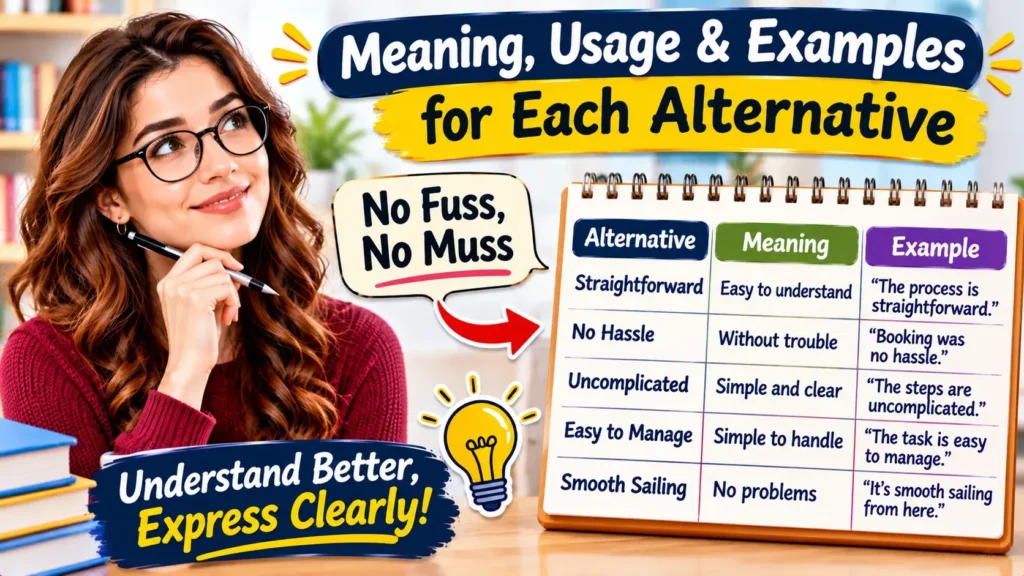
1. Straightforward
Meaning: Easy to understand or complete without unnecessary complications.
Best Use: Professional emails, reports, instructions, and meetings.
Tone: Neutral and professional.
Example: “The registration process is straightforward and takes only a few minutes.”
2. No Hassle
Meaning: Without inconvenience, difficulty, or unnecessary trouble.
Best Use: Customer service, shopping, travel, and casual conversations.
Tone: Friendly and casual.
Example: “You can change your delivery date online with no hassle.”
3. Simple and Easy
Meaning: Something that requires little difficulty or effort.
Best Use: Tutorials, educational content, and everyday explanations.
Tone: Plain and accessible.
Example: “The setup is simple and easy, even for beginners.”
4. Uncomplicated
Meaning: Free from unnecessary complexity or difficulty.
Best Use: Professional writing, reports, and presentations.
Tone: Neutral and slightly formal.
Example: “We need an uncomplicated approval process for routine requests.”
5. Easy to Manage
Meaning: Something that can be handled without excessive difficulty.
Best Use: Projects, schedules, workloads, and responsibilities.
Tone: Practical and supportive.
Example: “The weekly workload should be easy to manage.”
6. Streamlined
Meaning: Simplified by removing unnecessary steps or delays.
Best Use: Business communication and process improvements.
Tone: Professional and modern.
Example: “We’ve streamlined the onboarding process for new employees.”
7. Without Complications
Meaning: Without additional problems, difficulties, or obstacles.
Best Use: Professional instructions and precise explanations.
Tone: Neutral and direct.
Example: “Please follow these steps to complete the transfer without complications.”
8. Easy to Work Through
Meaning: A task or problem that can be handled without excessive difficulty.
Best Use: Workplace discussions, education, and problem-solving.
Tone: Supportive and conversational.
Example: “The remaining edits are easy to work through.”
9. Smooth Process
Meaning: An activity that progresses efficiently with few difficulties.
Best Use: Customer service, business communication, and event planning.
Tone: Positive and reassuring.
Example: “Preparation helped us achieve a smooth process.”
10. Nothing Complicated
Meaning: Something that does not involve difficult or confusing steps.
Best Use: Everyday conversations and informal instructions.
Tone: Casual and reassuring.
Example: “There’s nothing complicated about the setup; just follow the instructions.”
11. No Problem
Meaning: Something is acceptable, manageable, or not troublesome.
Best Use: Friendly conversations, chats, and customer service.
Tone: Casual and friendly.
Example: “No problem—I can move the meeting to Friday.”
12. Easy-Peasy
Meaning: Extremely easy, usually expressed playfully.
Best Use: Friendly conversations and informal social posts.
Tone: Playful and humorous.
Example: “Once you learn the steps, the weekly update is easy-peasy.”
13. Nice and Easy
Meaning: Something that can be done calmly and without difficulty.
Best Use: Everyday conversations and informal instructions.
Tone: Relaxed and friendly.
Example: “Let’s take it nice and easy this morning.”
14. No Big Deal
Meaning: Something that is not particularly difficult or troublesome.
Best Use: Casual conversations and friendly workplace exchanges.
Tone: Informal and reassuring.
Example: “No big deal if you cannot attend the morning meeting.”
15. Keep It Simple
Meaning: Avoid unnecessary complexity or extra steps.
Best Use: Planning, teamwork, presentations, and everyday discussions.
Tone: Direct and practical.
Example: “Let’s keep it simple and focus on the main requirements.”
16. Smooth Sailing
Meaning: Progress that continues without significant difficulty or interruption.
Best Use: Informal updates, conversations, and travel discussions.
Tone: Casual and optimistic.
Example: “The difficult part is finished, so the rest should be smooth sailing.”
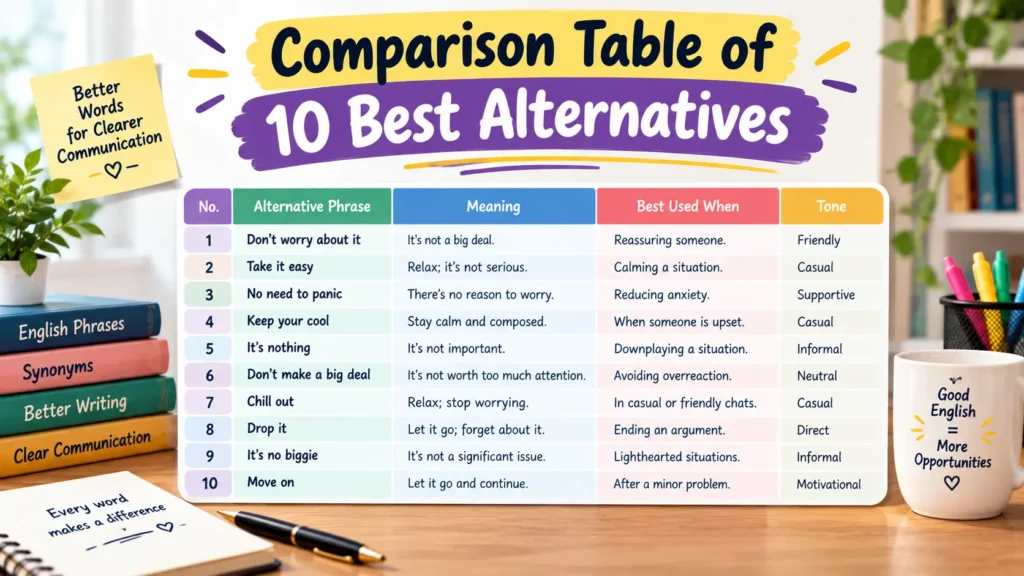
Comparison Table of 10 Best Alternatives
The following table compares ten useful alternatives based on their meanings, situations, and tones.
| Phrase | Meaning | Best Use | Tone |
|---|---|---|---|
| Straightforward | Easy to understand or complete | Professional communication | Neutral |
| No Hassle | Without inconvenience | Customer service | Casual |
| Simple and Easy | Requires little effort | Instructions | Friendly |
| Uncomplicated | Free from complexity | Reports | Professional |
| Easy to Manage | Simple to handle | Projects and workloads | Supportive |
| Streamlined | Simplified and efficient | Business processes | Professional |
| Without Complications | Free from problems | Formal instructions | Direct |
| No Problem | Not troublesome | Casual conversations | Friendly |
| Keep It Simple | Avoid complexity | Planning and teamwork | Practical |
| Smooth Sailing | Progress without difficulty | Informal updates | Optimistic |
Conclusion:
Choosing the right expression can make communication clearer, friendlier, and more appropriate for different situations. “No Fuss, No Muss” is useful for describing simple experiences, while alternatives such as “straightforward,” “no hassle,” and “uncomplicated” offer different tones for everyday and professional communication.
Understanding these differences helps ESL learners, students, and professionals use English more naturally. By considering your audience and purpose, you can select expressions that communicate simplicity without sounding repetitive or overly informal.
FAQs:
What does “No Fuss, No Muss” mean?
“No Fuss, No Muss” means something can be done easily without unnecessary trouble or complications. It is commonly used in informal English.
Is “No Fuss, No Muss” a professional phrase?
It is primarily informal but can work in relaxed workplace conversations. For formal writing, “straightforward” or “uncomplicated” is more suitable.
What are the best synonyms for “No Fuss, No Muss”?
Popular alternatives include “straightforward,” “no hassle,” “uncomplicated,” “simple and easy,” and “smooth sailing.” The best choice depends on the situation.
Is “No Fuss, No Muss” an idiom?
Yes, it is an informal English idiom meaning something happens without unnecessary difficulty, inconvenience, or complications.
What is the difference between “No Fuss, No Muss” and “No Hassle”?
“No Fuss, No Muss” emphasizes simplicity and minimal disruption, while “no hassle” focuses more on avoiding inconvenience or trouble.
Can I use “No Fuss, No Muss” in an email?
Yes, it works in informal emails and friendly workplace messages. In formal correspondence, “the process is straightforward” sounds more professional.
Is “No Fuss, No Muss” American or British English?
It is understood in both varieties, but the word “muss” has stronger informal North American associations. British speakers may prefer alternatives such as “straightforward.”
What is a formal alternative to “No Fuss, No Muss”?
“Straightforward,” “uncomplicated,” “efficient,” and “streamlined” are useful formal alternatives for professional communication.
Can “No Fuss, No Muss” sound rude?
It is not normally rude, but it may sound dismissive when used in serious situations or when someone is discussing a complicated problem.
What is the opposite of “No Fuss, No Muss”?
Possible opposites include “complicated,” “a hassle,” “difficult to manage,” and “full of complications.”