
Imagine a coworker accidentally spills coffee on an important document, a friend starts worrying about a small inconvenience, or a family member insists on making a simple situation much more complicated than necessary. In everyday English, someone might respond, “Don’t make a fuss.”
The phrase is short, familiar, and highly context-dependent. It can mean “don’t make a big issue out of this,” “don’t create unnecessary trouble,” or “don’t react too strongly.” However, the expression can sound caring in one situation and dismissive in another. That difference matters, especially in workplaces, customer communication, academic writing, and conversations with people from different English-speaking backgrounds.
What Does “Don’t Make a Fuss” Mean?
“Don’t make a fuss” means not to make a situation seem more serious, difficult, or important than it really is, or not to create unnecessary noise, worry, or excitement about something. It is commonly used when someone is reacting strongly to a minor problem, receiving attention, complaining, or making an otherwise simple situation more complicated.
The phrase can therefore have several closely related meanings:
- Don’t overreact.
- Don’t make a big issue of it.
- Don’t create unnecessary trouble.
- Don’t complain excessively.
- Don’t draw unnecessary attention to the situation.
- Don’t worry more than necessary.
The intended meaning depends heavily on tone, relationship, and context.
For example:
“It’s only a small scratch on the car. Don’t make a fuss.”
Here, the speaker means that the damage is minor and does not deserve an intense reaction.
But:
“Please don’t make a fuss about the mistake.”
could sound less supportive because it may suggest that the other person’s concern is excessive.
Origin & History of “Don’t Make a Fuss”

The expression comes from the noun “fuss,” which has long been associated with unnecessary excitement, agitation, complaint, or excessive attention. The exact historical development of the word is not completely certain, but English has used fuss for behavior involving needless commotion or concern for several centuries.
By the time “make a fuss” became an established English expression, it was commonly connected with creating unnecessary disturbance, complaining, or becoming overly concerned about something relatively minor. The construction follows a familiar English pattern in which “make” describes producing or creating a particular reaction or situation.
The negative imperative “don’t make a fuss” developed naturally from this expression. Instead of saying that someone is making a fuss, the speaker tells them to stop creating unnecessary commotion.
Synonyms & Alternatives by Tone
Professional & Neutral Alternatives
- Don’t make a big issue of it
- Let’s keep things simple
- Let’s not overcomplicate things
- There’s no need to make it a bigger issue
- Let’s keep this in perspective
- This doesn’t need to become a major concern
Polite & Supportive Alternatives
- There’s no need to worry
- Please don’t worry about it
- It’s nothing to be concerned about
- You don’t need to stress about it
- We can handle it without making it complicated
Encouraging & Reassuring Alternatives
- It’s not a big deal
- Take it easy
- Don’t stress
- Everything is under control
- We’ll sort it out
Casual, Playful & Idiomatic Alternatives
- Don’t make a scene
- Don’t make a production out of it
- Don’t make a big thing of it
- Keep it low-key
- Let’s not blow this out of proportion
The best alternative depends on what you actually want to communicate. “Don’t make a scene” focuses more on public behavior, while “It’s not a big deal” focuses on the seriousness of the problem. “There’s no need to worry” is more reassuring, whereas “Let’s keep things simple” is more collaborative.
When Should You Use “Don’t Make a Fuss”?
“Don’t make a fuss” is most effective when the speaker and listener have enough familiarity for the expression to sound natural rather than controlling or dismissive.
Professional Settings
In professional environments, use the phrase selectively. It can work in a friendly conversation between coworkers who know each other well:
“It’s just a small formatting issue. Don’t make a fuss—we can fix it before the meeting.”
However, when speaking to a client, manager, customer, or employee who is genuinely concerned, a softer alternative is usually safer.
Instead of:
“Don’t make a fuss about the delay.”
consider:
“I understand your concern, and we’ll work to resolve the delay.”
Casual Conversations
The phrase is very natural among friends and family.
“You remembered my birthday? You didn’t have to do that. Don’t make a fuss!”
In this situation, the phrase can actually communicate modesty and warmth rather than criticism.
Writing, Presentations, and Digital Communication
In blogs, informal articles, social posts, messages, and conversational writing, “don’t make a fuss” can make the language sound natural and approachable.
In formal reports or academic papers, however, alternatives such as “there is no need for further concern” or “the issue does not require additional attention” may be more appropriate.
When It Is Especially Effective
Use “don’t make a fuss” when:
- The issue is genuinely minor.
- You know the listener well.
- The tone is friendly or conversational.
- You want to discourage unnecessary attention.
- The situation does not require formal language.
- Your relationship allows direct communication.
When Should You Avoid “Don’t Make a Fuss”?
There are situations where the phrase can easily be misunderstood.
Overly Formal Situations
Avoid it in highly formal correspondence unless the surrounding language is deliberately conversational.
A formal report would normally say:
“The matter does not require further action at this stage.”
rather than:
“Don’t make a fuss about it.”
Legal, Academic, or Sensitive Contexts
Legal and academic communication depends on precision. “Don’t make a fuss” can be too subjective because it does not clearly define what behavior is excessive.
Similarly, when someone is discussing a serious personal problem, telling them not to make a fuss can sound insensitive.
Situations Where Nuance May Be Lost
Digital messages often lack facial expression and vocal tone. A sentence intended as reassurance may appear dismissive when read on a screen.
For example:
“Don’t make a fuss. It’ll be fine.”
could be interpreted as:
“Your concern is not important.”
If the recipient is already frustrated, a more supportive sentence is preferable.
Pros and Cons of Using “Don’t Make a Fuss”
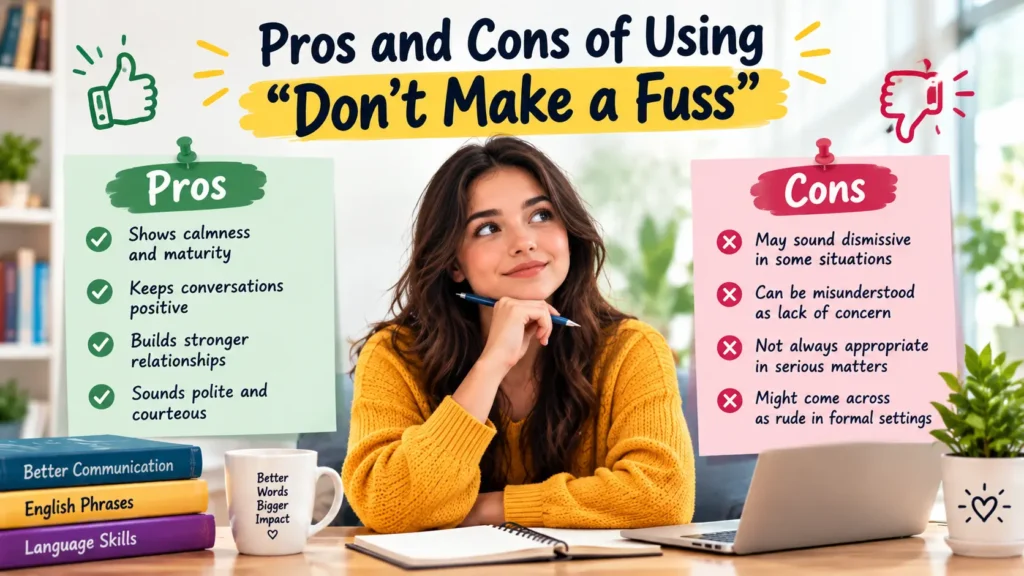
Advantages
- Clarity: It communicates the speaker’s desire to prevent unnecessary concern or commotion.
- Efficiency: The phrase expresses a relatively complex social message in only a few words.
- Accessibility: It is familiar to many native English speakers and is easy to understand from context.
- Naturalness: It sounds authentic in everyday conversation.
- Flexibility: It can be reassuring, humorous, or mildly firm depending on delivery.
Potential Drawbacks
- Oversimplification: It can make a genuine concern sound insignificant.
- Tone mismatch: The phrase may sound too casual for a formal workplace or sensitive situation.
- Repetition: Frequent use can make a speaker sound dismissive.
- Cultural differences: ESL learners may not immediately recognize how strongly tone affects the phrase.
- Digital ambiguity: A short written message may sound harsher than intended.
Real-Life Examples of “Don’t Make a Fuss” by Context
Emails
“Thanks for catching that formatting issue. I’ve corrected it now, so don’t make a fuss over the mistake—we’re still on track for tomorrow.”
This works best when the recipient is a colleague and the message is clearly reassuring.
Meetings
“The numbers on slide six are outdated, but we have the corrected figures ready. Don’t make a fuss; we can update the slide before the presentation.”
The phrase keeps the discussion focused, although a more formal team might prefer “Let’s not overcomplicate the issue.”
Presentations
A speaker might say:
“If you notice a small typo in the handout, don’t make a fuss. The information itself is correct.”
This gives the audience a clear signal that the typo does not affect the substance.
Conversations
“You don’t need to cook anything special for me. Don’t make a fuss.”
Here, the phrase is warm and familiar rather than dismissive.
Social Media
“The weather ruined the picnic, but don’t make a fuss—we still had a great afternoon together.”
On social media, the phrase can create a relaxed and conversational tone.
“Don’t Make a Fuss” vs Similar Expressions: Key Differences
| Phrase | Meaning Difference | Tone Difference | Best Use Scenario |
| Don’t make a big deal of it | Says the matter should not receive excessive importance | Casual, reassuring | Minor mistakes, favors, small problems |
| Don’t make a scene | Specifically discourages disruptive or noticeable behavior | Firmer and more critical | Public arguments or emotional outbursts |
| Don’t overreact | Directly says the person’s emotional response is too strong | More blunt | Situations where someone is responding excessively |
| It’s not a big deal | Reassures someone that the issue is minor | Friendly and supportive | Everyday problems and mistakes |
| There’s no need to worry | Focuses on reducing anxiety rather than stopping commotion | Gentle and reassuring | Personal concerns and stressful situations |
| Let’s keep things simple | Encourages a straightforward approach rather than unnecessary complexity | Professional and collaborative | Meetings, projects, planning |
The distinctions are important. “Don’t make a scene” is about visible behavior, while “there’s no need to worry” addresses anxiety. “Don’t make a big deal of it” is probably the closest everyday substitute, but even it can sound dismissive if the listener’s concern is legitimate.
Common Mistakes & Misuse of “Don’t Make a Fuss”
Overuse
Using “don’t make a fuss” whenever someone expresses concern can make you appear impatient.
If a colleague repeatedly raises a genuine problem, saying “don’t make a fuss” may shut down useful communication instead of solving the issue.
Incorrect Context
The phrase is inappropriate when a matter is genuinely serious.
For example, telling someone:
“Don’t make a fuss about the security problem.”
would be poor communication if the security problem requires immediate attention.
Contradictory Usage
The phrase can become confusing when the speaker is simultaneously asking for attention.
For example:
“Don’t make a fuss, but I need everyone to stop working immediately.”
In such a case, explain exactly what action is required instead of relying on an idiom.
Cultural Misunderstandings
ESL learners should remember that English idioms often communicate more than their dictionary definitions.
A listener may understand “don’t make a fuss” literally but miss the intended emotional message. Similarly, a speaker may use it kindly while the listener interprets it as criticism.
Psychological Reasons People Prefer “Don’t Make a Fuss”
Cognitive Load Reduction
Short expressions reduce the amount of language needed to communicate a familiar social idea. “Don’t make a fuss” quickly signals that the speaker considers additional attention unnecessary.
Trust and Authority Signals
In some relationships, confident language can reassure people that a situation is under control. However, confidence works only when the speaker has enough credibility.
Attention Economy
Modern communication is often fast. Emails, messages, meetings, and social posts reward concise language. Idioms such as “don’t make a fuss” efficiently communicate an attitude toward a situation.
Modern Communication Habits
People increasingly communicate through short messages where context is limited. This makes familiar expressions useful, but it also increases the risk of tone being misunderstood.
For that reason, experienced communicators often add context:
“It’s a minor issue, and we’ve already fixed it, so there’s no need to worry.”
This is longer than “don’t make a fuss,” but it is clearer and more supportive.
“Don’t Make a Fuss” in Digital & Modern Communication
Emails
Email requires greater caution because the recipient cannot hear your voice. A phrase that sounds friendly aloud may look abrupt in writing.
Instead of:
“Don’t make a fuss about this.”
consider:
“It’s a minor issue, and we’ve already taken care of it.”
Slack / WhatsApp
Short informal messages are more suitable for the phrase:
“No worries—don’t make a fuss. I’ll handle it.”
Among familiar colleagues or friends, this can sound natural.
Social Media
The phrase works well in conversational posts and captions:
“My cake collapsed five minutes before the party. Don’t make a fuss—we ate it anyway!”
Here, humor makes the intended tone obvious.
AI-Generated Summaries
AI-generated communication should be careful with expressions such as “don’t make a fuss.” Automated text may not know whether the recipient will perceive the phrase as reassuring or dismissive.
For professional summaries, clearer language is often preferable:
“The issue is minor and does not require additional action.”
This communicates the same basic idea without relying on emotional interpretation.
Meaning, Usage & Examples for Each Alternative

Don’t Make a Big Deal of It
Meaning: “Don’t make a big deal of it” means that something should not be treated as unusually important, serious, or significant. It is one of the closest everyday alternatives to “don’t make a fuss.” Why This Phrase Works: It directly reduces the perceived importance of a minor problem without necessarily referring to noise or public behavior. Real-World Usage Insight: Native speakers frequently use it after an apology, small favor, mistake, or inconvenience. Best Use: Casual conversations, friendly workplaces, and everyday reassurance. Avoid When: Someone has raised a serious concern that deserves careful attention. Tone: Casual, friendly, and usually reassuring. US vs UK Usage: Very common in both varieties, with particularly strong everyday use in American English. Example (Email / Message / Meeting): “Thanks for apologizing about the missed attachment, but don’t make a big deal of it. I’ve added the file to the shared folder.”
Don’t Make a Scene
Meaning: “Don’t make a scene” tells someone not to behave in a visibly disruptive, dramatic, or embarrassing way, particularly in public. Why This Phrase Works: It is precise when the problem is public behavior rather than private worry. Real-World Usage Insight: It often appears during arguments, complaints, or emotional moments in public places. Best Use: Situations involving public disruption or unwanted attention. Avoid When: Someone is privately anxious or dealing with a legitimate emotional difficulty. Tone: Firm, direct, and sometimes critical. US vs UK Usage: Common and easily understood in both American and British English. Example (Email / Message / Meeting): “We were already running late at the airport, so I quietly asked him not to make a scene at the check-in desk.”
Don’t Overreact
Meaning: “Don’t overreact” means that someone’s emotional or practical response is believed to be stronger than the situation requires. Why This Phrase Works: It communicates the idea very directly and leaves little uncertainty about the speaker’s judgment. Real-World Usage Insight: It is common when someone becomes worried or angry about incomplete information. Best Use: Informal conversations when directness is acceptable. Avoid When: The person may feel vulnerable or when their concern has not yet been properly understood. Tone: Blunt, firm, and potentially dismissive. US vs UK Usage: Widely used in both varieties. Example (Email / Message / Meeting): “Let’s wait until we hear back from the supplier before we decide what went wrong. Don’t overreact to the first email.”
It’s Not a Big Deal
Meaning: “It’s not a big deal” reassures someone that a problem, mistake, inconvenience, or event is relatively minor. Why This Phrase Works: Instead of directly criticizing someone’s behavior, it describes the situation as insignificant. Real-World Usage Insight: It is especially common after someone apologizes or worries about causing inconvenience. Best Use: Friendly conversation, informal work messages, and everyday situations. Avoid When: The recipient clearly believes the issue has serious consequences. Tone: Relaxed, reassuring, and conversational. US vs UK Usage: Extremely familiar in both American and British English. Example (Email / Message / Meeting): “You don’t need to apologize for being five minutes late. It’s not a big deal; we hadn’t started the main discussion yet.”
There’s No Need to Worry
Meaning: “There’s no need to worry” focuses on reducing anxiety rather than discouraging someone from creating a disturbance. Why This Phrase Works: It sounds more supportive because it addresses the person’s emotional state directly. Real-World Usage Insight: It is useful when someone is nervous about an outcome that appears manageable. Best Use: Reassurance, customer communication, personal conversations, and supportive workplace situations. Avoid When: You cannot honestly assure someone that the situation is safe or under control. Tone: Gentle, calm, and supportive. US vs UK Usage: Natural and common in both varieties. Example (Email / Message / Meeting): “There’s no need to worry about the report. I reviewed the figures this morning, and everything is ready for submission.”
Don’t Worry About It
Meaning: “Don’t worry about it” tells someone that they do not need to remain concerned about a particular problem or responsibility. Why This Phrase Works: It is simple, familiar, and emotionally reassuring. Real-World Usage Insight: The phrase can also be used to accept an apology or tell someone that a small favor is unnecessary. Best Use: Friendly messages, casual workplace communication, and personal conversations. Avoid When: You need to formally acknowledge responsibility or provide detailed reassurance. Tone: Casual, warm, and flexible. US vs UK Usage: Common across both varieties. Example (Email / Message / Meeting): “Don’t worry about it—I found the missing spreadsheet in the archived folder and have attached it here.”
Keep It Low-Key
Meaning: “Keep it low-key” means to keep something quiet, simple, restrained, or not overly noticeable. Why This Phrase Works: It emphasizes a low level of attention or excitement rather than telling someone that their concern is unreasonable. Real-World Usage Insight: It is particularly useful for social plans, celebrations, announcements, and informal situations. Best Use: Friends, informal teams, social media, and casual planning. Avoid When: Writing formal business communication. Tone: Casual, modern, and relaxed. US vs UK Usage: Well understood in both, although American informal speech uses it particularly often. Example (Email / Message / Meeting): “It’s Sarah’s last day, so we’re keeping it low-key with coffee and cake rather than planning a big office event.”
Don’t Make a Big Thing of It
Meaning: “Don’t make a big thing of it” means not to give excessive attention or importance to an event, mistake, favor, or problem. Why This Phrase Works: It closely matches the social meaning of “don’t make a fuss” while emphasizing importance rather than commotion. Real-World Usage Insight: The expression is particularly natural when someone is being thanked or praised for something they consider ordinary. Best Use: Informal conversation and friendly interactions. Avoid When: Someone is expressing a serious concern or requesting professional support. Tone: Informal and reassuring. US vs UK Usage: Common in both, with the wording especially familiar in British and other varieties of UK English. Example (Email / Message / Meeting): “I was happy to help with the presentation, so don’t make a big thing of it. We’re on the same team.”
Take It Easy
Meaning: “Take it easy” can mean relax, avoid unnecessary stress, or reduce the intensity of your response. Why This Phrase Works: It focuses on calming the person rather than criticizing their behavior. Real-World Usage Insight: The phrase can also mean goodbye or advise someone to rest, so context is important. Best Use: Friendly conversations and informal reassurance. Avoid When: You need to communicate a specific action or deal with a serious complaint. Tone: Relaxed, friendly, and casual. US vs UK Usage: Familiar in both American and British English. Example (Email / Message / Meeting): “Take it easy—we still have two hours before the deadline, and the main sections are already finished.”
Let’s Not Overcomplicate Things
Meaning: “Let’s not overcomplicate things” suggests that a situation should remain straightforward rather than receiving unnecessary procedures, discussion, or attention. Why This Phrase Works: It is more collaborative than directly telling another person to stop making a fuss. Real-World Usage Insight: This expression is particularly effective in meetings and project discussions where people are adding unnecessary steps. Best Use: Professional communication, planning, meetings, and teamwork. Avoid When: A complicated issue genuinely requires detailed analysis. Tone: Professional, calm, and collaborative. US vs UK Usage: Natural in both varieties. Example (Email / Message / Meeting): “We already have the information we need, so let’s not overcomplicate things by creating another spreadsheet.”
Don’t Stress
Meaning: “Don’t stress” means that someone should avoid becoming overly anxious or worried about a situation. Why This Phrase Works: It is short, modern, and emotionally accessible. Real-World Usage Insight: It is particularly common in texts, instant messages, and informal conversations between people who know each other. Best Use: Casual communication and friendly reassurance. Avoid When: The recipient is facing a serious issue that requires acknowledgment rather than dismissal. Tone: Very casual, supportive, and contemporary. US vs UK Usage: Common in both varieties, especially in informal digital communication. Example (Email / Message / Meeting): “Don’t stress about the formatting. I’ll clean up the final document before we send it to the client.”
Comparison Table of 10 Best Alternatives
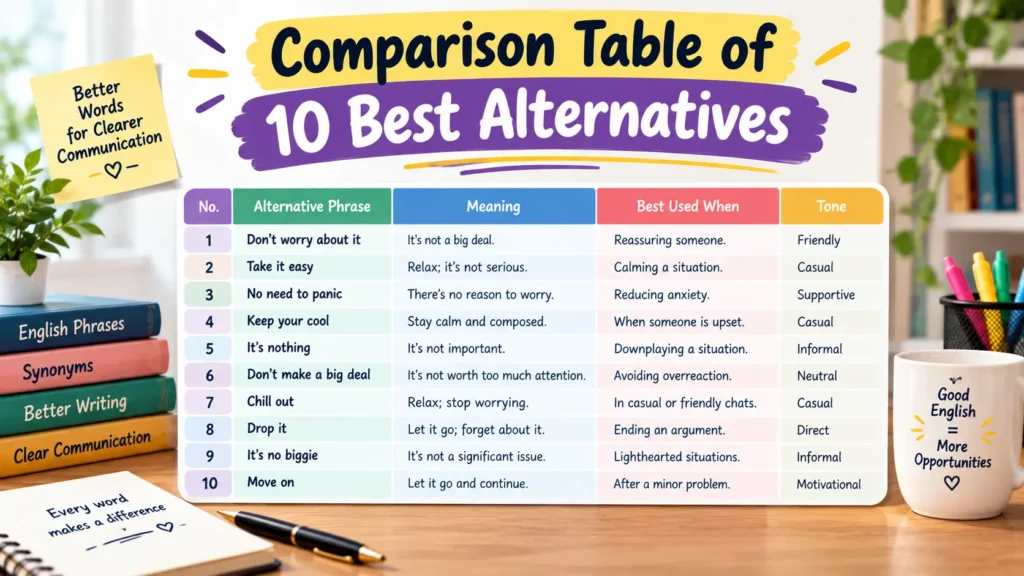
The following alternatives are especially useful because they cover different levels of formality, directness, reassurance, and emotional sensitivity. Choosing among them allows you to preserve the intended meaning without creating an unintended tone problem.
| Phrase | Meaning | Best Use | Worst Use | Tone | US vs UK Usage |
| Don’t Make a Big Deal of It | Treat the matter as minor | Casual reassurance | Serious complaints | Friendly, casual | Very common in both |
| Don’t Make a Scene | Avoid disruptive public behavior | Public disagreements | Private anxiety | Firm | Common in both |
| Don’t Overreact | Reduce an excessive response | Informal discussions | Sensitive concerns | Blunt | Common in both |
| It’s Not a Big Deal | The issue is minor | Apologies and mistakes | Serious problems | Reassuring | Very common in both |
| There’s No Need to Worry | Anxiety is unnecessary | Supportive communication | Situations with real risk | Gentle | Common in both |
| Don’t Worry About It | Stop being concerned | Friends and coworkers | Formal complaints | Casual | Common in both |
| Let’s Keep Things Simple | Avoid unnecessary complexity | Meetings and projects | Complex safety issues | Collaborative | Common in both |
| Don’t Stress | Avoid unnecessary anxiety | Texts and casual messages | Formal correspondence | Very casual | Common in both |
| Let’s Not Overcomplicate Things | Keep the approach straightforward | Professional teamwork | Issues requiring deep analysis | Practical | Common in both |
| It’s Nothing to Be Concerned About | The issue does not warrant worry | Professional reassurance | Serious unresolved problems | Calm, formal | Common in both |
Conclusion:
Understanding “Don’t Make a Fuss” is useful for anyone who wants to communicate naturally and appropriately in English. The phrase generally means not to make something seem more serious, important, or troublesome than it really is. It is common in everyday conversations and can sound friendly, reassuring, humorous, or slightly dismissive depending on the speaker’s tone and relationship with the listener.
For ESL learners, the most important point is that the phrase should not be translated literally without considering context. In professional communication, alternatives such as “There’s no need to worry,” “Let’s keep things simple,” or “It’s not a big deal” may sound more suitable. In casual conversations, “Don’t Make a Fuss” can feel completely natural and conversational. Choosing the right alternative helps you communicate your intention more clearly while avoiding unintended offense. Ultimately, understanding its meaning, tone, synonyms, and practical usage can make your spoken and written English more precise, natural, and confident.
FAQs:
[faq_accordion]What does “Don’t Make a Fuss” mean?
“Don’t Make a Fuss” means not to create unnecessary concern, excitement, complaint, disturbance, or attention about something. It is usually said when the speaker considers an issue relatively minor or believes someone is reacting too strongly. The exact tone depends on context and can range from friendly reassurance to mild criticism or dismissal.
Is “Don’t Make a Fuss” rude?
“Don’t Make a Fuss” is not automatically rude, but it can sound dismissive in sensitive situations. Among friends or family, it may sound warm and reassuring. However, telling a customer, employee, or genuinely upset person not to make a fuss can minimize their concern. A softer alternative such as “There’s no need to worry” may be safer.
Is “Don’t Make a Fuss” professional?
The phrase is generally considered informal or conversational, rather than highly professional. It can be acceptable between familiar coworkers, but it may not suit formal emails, reports, legal writing, or sensitive workplace conversations. Professional alternatives include “Let’s keep things simple,” “There’s no need for further concern,” or “The issue has already been resolved.”
What is another way to say “Don’t Make a Fuss”?
Common alternatives include “Don’t make a big deal of it,” “It’s not a big deal,” “Don’t worry about it,” “There’s no need to worry,” “Don’t overreact,” and “Let’s keep things simple.” The best synonym depends on your intended tone. Some alternatives are supportive, while others are more direct, professional, casual, or critical.
What is the difference between “Don’t Make a Fuss” and “Don’t Make a Scene”?
“Don’t Make a Fuss” has a broader meaning and can refer to unnecessary worry, complaints, attention, or disturbance. “Don’t make a scene” specifically focuses on disruptive or dramatic behavior, especially in public. Therefore, “don’t make a scene” is stronger and more specific when someone is behaving noticeably or emotionally in front of others.
Can “Don’t Make a Fuss” be used in an email?
Yes, but it is best suited to informal emails between people who know each other well. Written messages lack vocal tone, so the phrase can sometimes appear harsher than intended. In professional emails, alternatives such as “There’s no need to worry about this” or “It’s a minor issue, and we have already resolved it” are often clearer.
Is “Don’t Make a Fuss” British or American English?
“Don’t Make a Fuss” is understood in both British and American English. The expression “make a fuss” is especially familiar in British English, while American speakers may also commonly say “don’t make a big deal out of it.” These are differences in preference rather than meaning, and the original phrase is natural across both varieties.
What is the opposite of “Don’t Make a Fuss”?
The opposite idea would be to make a big deal about something, draw attention to it, complain about it, or make a scene. The exact opposite depends on context. If someone is becoming overly worried, the opposite might be “make a big deal of it.” If someone is creating public disruption, “make a scene” is more precise.
Is “Don’t Make a Fuss” suitable for ESL learners?
Yes. ESL learners can use the phrase effectively in casual conversations, but they should understand its tone as well as its meaning. It can be friendly among close acquaintances but may sound dismissive in sensitive situations. Learning alternatives such as “Don’t worry,” “It’s not a big deal,” and “Let’s keep things simple” gives learners greater control over tone.
What is the most polite alternative to “Don’t Make a Fuss”?
“There’s no need to worry” is often one of the most polite alternatives when the goal is reassurance. For professional situations involving unnecessary complexity, “Let’s keep things simple” may be better. If someone has raised a genuine concern, acknowledge it first rather than immediately minimizing it. This approach sounds more respectful and supportive.
[/faq_accordion]