
Imagine a colleague explaining a project decision and saying, “So, you rejected the proposal because you disliked the idea.” You might respond, “That is not it at all. I actually liked the idea; the problem was the deadline.” In a few words, the speaker corrects a misunderstanding without needing a long explanation.
“That Is Not It At All” is a useful English phrase for rejecting an incorrect interpretation, assumption, explanation, or description. It tells the listener that something they have said or understood is completely different from the actual situation.
The phrase matters because modern communication often happens quickly through emails, meetings, messaging apps, social media, and short conversations. A speaker needs language that can correct a misunderstanding clearly while still choosing the right level of politeness. Depending on the situation, alternatives such as “That’s not quite right,” “That’s not what I meant,” “That’s not the case,” or “That’s completely different” may sound more appropriate.
What Does “That Is Not It At All” Mean?
“That Is Not It At All” means that a particular explanation, interpretation, assumption, or description is completely incorrect. It is commonly used when someone has misunderstood what another person means, why something happened, or what the real issue is. The phrase directly rejects the suggested idea and signals that the actual situation is different.
Origin & History of “That Is Not It At All”
The phrase “That is not it at all” does not have a single documented inventor or a specific historical event associated with its creation. Instead, it developed naturally from ordinary English sentence patterns.
The construction combines three familiar elements: “that,” “is not,” and “at all.” The word “that” points to an idea, statement, explanation, or situation. “Is not” provides the negative judgment, while “at all” strengthens the negative meaning.
The expression “not … at all” has long been used in English to emphasize complete absence or complete negation. For example, “I am not tired at all” means the speaker feels no tiredness. Similarly, “That is not it at all” means the suggested explanation is not correct in any meaningful sense.
Over time, the phrase became particularly useful in conversation because people frequently need to correct assumptions. Someone may misunderstand a person’s intention, confuse two issues, or draw the wrong conclusion. Rather than giving a lengthy correction immediately, a speaker can first say, “That is not it at all,” and then explain the real situation.
In modern English, the expression remains understandable and natural, although shorter alternatives such as “That’s not it,” “That’s not what I meant,” and “Not at all” may be preferred in fast digital communication.
Synonyms & Alternatives by Tone
Professional & Neutral Alternatives
- That’s not quite right.
- That’s not the case.
- That’s not what I meant.
- That isn’t accurate.
- That’s not the issue.
- That’s a different matter.
- That’s not the situation.
Polite & Supportive Alternatives
- I think there may be a misunderstanding.
- That’s not quite what I meant.
- Let me clarify what I mean.
- I understand why you might think that, but that isn’t the case.
- There’s a slight misunderstanding here.
- Let me explain what I intended.
Encouraging & Reassuring Alternatives
- That’s not the problem.
- We’re looking at it from the wrong angle.
- The situation is a little different.
- You’re close, but that’s not quite it.
- That’s not what’s happening.
- The main issue is something else.
Casual, Playful & Idiomatic Alternatives
- That’s not it.
- Nope, not at all.
- That’s not even close.
- You’ve got the wrong idea.
- That’s a whole different story.
- Not quite.
- That’s not how it is.
- That’s not the point.
When Should You Use “That Is Not It At All”?
“That Is Not It At All” works best when you need to make it clear that another person’s interpretation is substantially wrong. It is particularly useful when the misunderstanding concerns intention, motivation, meaning, or the cause of an event.
Professional Settings
In a workplace, the phrase can be useful when correcting an inaccurate assumption:
“That is not it at all. We postponed the launch because the testing phase was incomplete.”
However, workplace communication often benefits from slightly softer wording. “That’s not quite what happened” or “That’s not what I meant” can reduce the possibility that the listener feels criticized.
Casual Conversations
The expression is very natural in everyday conversation. Friends and family members often use it when someone makes the wrong assumption.
“You think I’m avoiding the party? That is not it at all. I’m just exhausted.”
Writing, Presentations, and Digital Communication
The phrase can appear in articles, interviews, presentations, emails, comments, and messages. In formal writing, however, alternatives such as “That interpretation is not accurate” may be more suitable.
When It Is Especially Effective
Use the phrase when:
- Someone has misunderstood your intention.
- An explanation is completely wrong.
- You need to correct an assumption quickly.
- The difference between two interpretations matters.
- You want to emphasize that the reality is substantially different.
When Should You Avoid “That Is Not It At All”?
Although the expression is clear, it is not ideal for every situation.
Overly Formal Situations
In legal documents, academic research, official reports, and highly formal correspondence, “That is not it at all” may sound conversational. More precise language such as “That interpretation is incorrect” may be preferable.
Legal, Academic, or Sensitive Contexts
Sensitive subjects require careful wording. A blunt rejection can make a discussion more defensive. Instead of saying:
“That is not it at all.”
you could write:
“That interpretation does not accurately reflect the circumstances.”
Situations Where Nuance May Be Lost
Sometimes another person’s interpretation is not completely wrong; it is simply incomplete. In that situation, “That is not it at all” may be too absolute.
For example:
“You think cost was the only reason? That is not it at all.”
If cost actually played a small role, the statement could create confusion. “Cost was one factor, but it wasn’t the main reason” would be more accurate.
Pros and Cons of Using “That Is Not It At All”
Advantages
- Clarity: It clearly signals that an interpretation is incorrect.
- Efficiency: It corrects a misunderstanding in very few words.
- Accessibility: The vocabulary is simple and easy for ESL learners to understand.
- Directness: It prevents an incorrect assumption from continuing.
- Conversational naturalness: Native speakers can use it comfortably in everyday dialogue.
Potential Drawbacks
- Oversimplification: It can make a partly correct interpretation sound completely wrong.
- Tone mismatch: In sensitive conversations, it may sound more forceful than intended.
- Repetition: Frequent use can make speech sound predictable.
- Limited precision: It does not explain what the correct interpretation actually is.
- Possible defensiveness: The listener may feel that their understanding has been dismissed.
Real-Life Examples of “That Is Not It At All” by Context

“Thanks for raising that point. That is not it at all—the reason we moved the deadline was the vendor delay, not the quality of the draft.”
Meeting
“That is not it at all. The team supports the new process; we just need another week to test it.”
Presentation
“Some people assume the project is about reducing costs. That is not it at all. The main goal is improving customer response time.”
Conversation
“You think I’m upset with you? That is not it at all. I’ve just had a really long day.”
Social Media
“Everyone thinks the update is about removing the feature, but that is not it at all. The team is actually redesigning how it works.”
“That Is Not It At All” vs Similar Expressions
| Phrase | Meaning Difference | Tone Difference | Best Use Scenario |
| That’s not quite right | Says an idea is inaccurate but may contain some truth. | Softer and more diplomatic. | Workplace discussions and corrections. |
| That’s not what I meant. | Specifically corrects the speaker’s intended meaning. | Personal, clear, and polite. | Conversations, emails, and explanations. |
| That’s not the case | States that a claimed situation is factually incorrect. | Neutral and professional. | Reports, meetings, and formal communication. |
| That’s not the point | Says the listener has focused on the wrong issue. | Direct and sometimes firm. | Discussions and debates. |
| That’s not even close | Emphasizes that the guess is very far from reality. | Casual and stronger. | Informal conversations. |
| There’s a misunderstanding | Identifies a communication problem rather than simply rejecting an idea. | Diplomatic and collaborative. | Sensitive or professional situations. |
The key distinction is what exactly you are correcting. “That’s not what I meant” focuses on intention. “That’s not the case” focuses on facts. “That’s not the point” focuses on relevance, while “That’s not quite right” allows for partial correctness.
Common Mistakes & Misuse of “That Is Not It At All”
Overuse
Using the phrase every time someone makes a small mistake can make communication sound unnecessarily blunt. Reserve it for situations where the misunderstanding is genuinely significant.
Incorrect Context
Do not use it when you simply want to add another perspective. If someone is partly correct, say:
“That’s one part of it, but there’s another factor.”
Contradictory Usage
The phrase communicates strong rejection. Saying “That is not it at all” and then agreeing with most of the original statement creates a contradiction.
Cultural Misunderstandings
ESL speakers may interpret the phrase as automatically rude. It is not inherently rude, but its directness can be perceived differently across cultures and workplaces. A softer alternative may be safer when communicating with someone unfamiliar with your conversational style.
Psychological Reasons People Prefer “That Is Not It At All”
Cognitive Load Reduction
People often need a quick way to stop an incorrect interpretation before explaining the details. A short corrective phrase gives the listener a clear signal that the current assumption should be reconsidered.
Trust and Authority Signals
Clear correction can demonstrate confidence. When used appropriately, it shows that the speaker understands the situation and is willing to clarify it.
However, excessive certainty can have the opposite effect. If the speaker rejects every alternative interpretation, listeners may perceive the communication as dismissive.
Attention Economy
Modern communication rewards concise language. Emails, chats, notifications, and social media encourage short statements that communicate the main point quickly.
Modern Communication Habits
Digital conversations often lack facial expressions, gestures, and vocal tone. Because of this, direct phrases can sometimes be misunderstood. Adding a short explanation after the phrase can make the intended tone clearer.
US vs UK Usage of “That Is Not It At All”

The phrase is understandable and usable in both American and British English. There is no major grammatical difference between US and UK English for this expression.
In American English, conversational alternatives such as “That’s not it,” “That’s not what I meant,” and “That’s not the point” are common.
In British English, “That’s not quite right” can often provide a softer correction, especially in polite conversation. However, British speakers can also use “That is not it at all” naturally when they want strong clarification.
The difference is therefore more about tone, situation, and individual speaking style than a strict regional rule.
Linguistic & Communication Insight
Emotional Weight & Subtext
Literally, “That is not it at all” means that something is completely incorrect. Pragmatically, however, it can communicate more than factual disagreement.
Depending on voice and context, it can signal:
- correction,
- surprise,
- frustration,
- reassurance,
- disagreement,
- or urgency.
A warm tone can make it sound reassuring:
“You think I’m disappointed? That’s not it at all.”
A sharp tone can make it sound confrontational:
“That is not it at all. You clearly misunderstood the instructions.”
The words remain the same, but the social meaning changes.
Direct vs Indirect Phrasing
“That is not it at all” is direct because it immediately rejects an interpretation.
A softer alternative such as “I think there may be a misunderstanding” creates more conversational space. It does not directly tell the listener that their interpretation is wrong; instead, it frames the problem as a shared communication issue.
This difference matters when the goal is collaboration rather than correction alone.
Professional Communication Perspective
In professional communication, the best phrase depends on the relationship and the seriousness of the misunderstanding.
If a factual error must be corrected quickly, “That’s not the case” is efficient.
If a colleague misunderstood your intention, “That’s not what I meant” is more precise.
If the other person’s interpretation is partially reasonable, “That’s not quite right” is safer.
Pragmatic Reasons for Alternatives
Experienced communicators often choose alternatives because they want to correct the message without damaging the relationship.
Compare:
“That is not it at all.”
with:
“I see why you interpreted it that way, but that’s not quite what I meant.”
The second version takes longer but acknowledges the other person’s perspective. This can reduce defensiveness and encourage continued discussion.
Social Signaling
Language communicates social attitudes as well as information. Direct corrections can signal confidence and authority, while softer corrections can signal patience and cooperation.
Neither approach is universally better. The strongest communicator chooses based on the audience, relationship, stakes, and desired outcome.
Tone & Context Guidance
Use “That is not it at all” when a strong but understandable correction is appropriate. Consider an alternative when:
- the listener has some part of the interpretation correct;
- the topic is sensitive;
- you are speaking to a senior colleague;
- the relationship is new;
- the communication is formal;
- the written message could easily sound harsher than intended.
That’s Not Quite Right
Meaning: This phrase means that something is incorrect or inaccurate, but it does not necessarily mean it is completely wrong. It is especially useful when correcting someone diplomatically.
Why This Phrase Works: It provides a clear correction without immediately rejecting the other person’s entire understanding. The word “quite” softens the statement.
Real-World Usage Insight: This is one of the safest alternatives for professional communication because it leaves room for discussion and correction.
Best Use: Meetings, workplace conversations, feedback, customer communication, and polite disagreement.
Avoid When: You need to make it unmistakably clear that an idea is completely unrelated to the actual issue.
Tone: Polite, neutral, diplomatic, professional.
US vs UK Usage: Common in both varieties of English. It can have a particularly understated and polite feel in British communication.
Example (Meeting): “That’s not quite right. The customer asked us to change the delivery date, but they didn’t request a change to the product.”
That’s Not What I Meant
Meaning: This phrase tells someone that they have misunderstood the speaker’s intended meaning, intention, or message.
Why This Phrase Works: It identifies the exact problem: the listener has interpreted the speaker’s words differently from what was intended.
Real-World Usage Insight: This is often better than saying “That is not it at all” when the issue concerns your own communication rather than the other person’s intelligence or judgment.
Best Use: Conversations, emails, interviews, workplace discussions, and clarification.
Avoid When: The problem is a factual situation rather than your intended meaning.
Tone: Clear, personal, neutral, and generally polite.
US vs UK Usage: Very common in both American and British English.
Example (Email): “Thanks for checking. That’s not what I meant in the last paragraph. I was referring to the July figures, not the full-year results.”
That’s Not the Case
Meaning: This phrase means that a particular claim, assumption, or description does not accurately describe the actual situation.
Why This Phrase Works: It focuses on the facts rather than blaming the person who made the statement.
Real-World Usage Insight: It is particularly effective when correcting information in professional settings.
Best Use: Business emails, reports, presentations, customer support, and formal conversations.
Avoid When: You are trying to explain a personal intention or emotional reaction.
Tone: Neutral, professional, factual.
US vs UK Usage: Widely used in both US and UK English.
Example (Email): “The article suggests that the service is unavailable to new customers. That’s not the case; new accounts are currently being accepted.”
That’s Not the Point
Meaning: This expression means that someone has focused on an issue that is not the main subject or purpose of the discussion.
Why This Phrase Works: It redirects attention toward the central issue instead of debating an unrelated detail.
Real-World Usage Insight: It is useful when conversations become distracted by secondary points.
Best Use: Meetings, discussions, debates, and informal conversations.
Avoid When: Speaking to someone who may interpret direct disagreement as dismissive.
Tone: Direct, firm, sometimes argumentative.
US vs UK Usage: Common in both varieties of English.
Example (Conversation): “I know the room is small, but that’s not the point. We need to decide whether the event should go ahead.”
That’s a Different Matter
Meaning: This phrase says that the issue being discussed is separate from the original subject or requires a different consideration.
Why This Phrase Works: It distinguishes two issues without necessarily declaring either one wrong.
Real-World Usage Insight: It is useful when a conversation mixes related but separate questions.
Best Use: Professional discussions, interviews, essays, and analytical conversations.
Avoid When: You need to directly correct a false assumption.
Tone: Neutral, controlled, analytical.
US vs UK Usage: Natural in both US and UK English.
Example (Meeting): “The redesign should improve usability. Whether it will reduce support costs is a different matter.”
I Think There May Be a Misunderstanding
Meaning: This phrase suggests that the people involved may not have understood each other’s meaning correctly.
Why This Phrase Works: It frames the problem as a communication issue rather than assigning blame.
Real-World Usage Insight: It is especially valuable when preserving a professional relationship is more important than making a forceful correction.
Best Use: Customer service, workplace communication, sensitive discussions, and conflict resolution.
Avoid When: You need an immediate, unequivocal correction.
Tone: Diplomatic, respectful, collaborative.
US vs UK Usage: Common and natural in both regions.
Example (Email): “I think there may be a misunderstanding regarding the invoice. The quoted amount covered delivery as well as installation.”
That’s Not Quite What I Meant
Meaning: This phrase means that the listener’s interpretation is close to the intended meaning but still inaccurate.
Why This Phrase Works: It combines correction with politeness and avoids suggesting that the listener was completely wrong.
Real-World Usage Insight: This is a strong choice when the other person has understood part of your message correctly.
Best Use: Feedback, conversations, presentations, emails, and collaborative work.
Avoid When: The misunderstanding is so severe that a much stronger correction is necessary.
Tone: Polite, patient, cooperative.
US vs UK Usage: Common in both American and British English.
Example (Meeting): “That’s not quite what I meant. I’m suggesting we move the deadline, not remove the testing stage.”
That’s Not the Situation
Meaning: This phrase states that someone’s description does not match the circumstances that actually exist.
Why This Phrase Works: It provides a direct factual correction without focusing heavily on the person who made the mistake.
Real-World Usage Insight: It works well when discussing changing circumstances, business conditions, or practical problems.
Best Use: Workplace discussions, explanations, customer communication, and reports.
Avoid When: You are correcting the meaning of your own words.
Tone: Neutral, factual, moderately formal.
US vs UK Usage: Understood and used in both varieties.
Example (Email): “The report assumes that demand has fallen, but that’s not the situation we’re seeing this quarter.”
That’s Not What’s Happening
Meaning: This phrase tells someone that their description of an ongoing event or situation is incorrect.
Why This Phrase Works: It is concrete and focuses on what is actually happening rather than debating abstract interpretations.
Real-World Usage Insight: It is particularly natural in conversations about current events or misunderstandings.
Best Use: Meetings, conversations, customer support, and real-time messaging.
Avoid When: Discussing historical facts or carefully qualified academic claims.
Tone: Direct, conversational, clear.
US vs UK Usage: Common in both US and UK English.
Example (Chat): “No, that’s not what’s happening. The system isn’t down; the login service is just running slowly.”
Let Me Clarify What I Mean
Meaning: This phrase introduces an explanation intended to remove confusion about a previous statement.
Why This Phrase Works: Instead of focusing on the mistake, it focuses on improving shared understanding.
Real-World Usage Insight: It is a highly useful phrase when you want to take responsibility for possible ambiguity in your own communication.
Best Use: Presentations, meetings, emails, teaching, and professional discussions.
Avoid When: A simple one-line correction would be sufficient.
Tone: Professional, cooperative, explanatory.
US vs UK Usage: Natural in both varieties of English.
Example (Presentation): “Let me clarify what I mean. We are not reducing the team’s responsibilities; we are changing how those responsibilities are divided.”
Comparison Table of 10 Best Alternatives
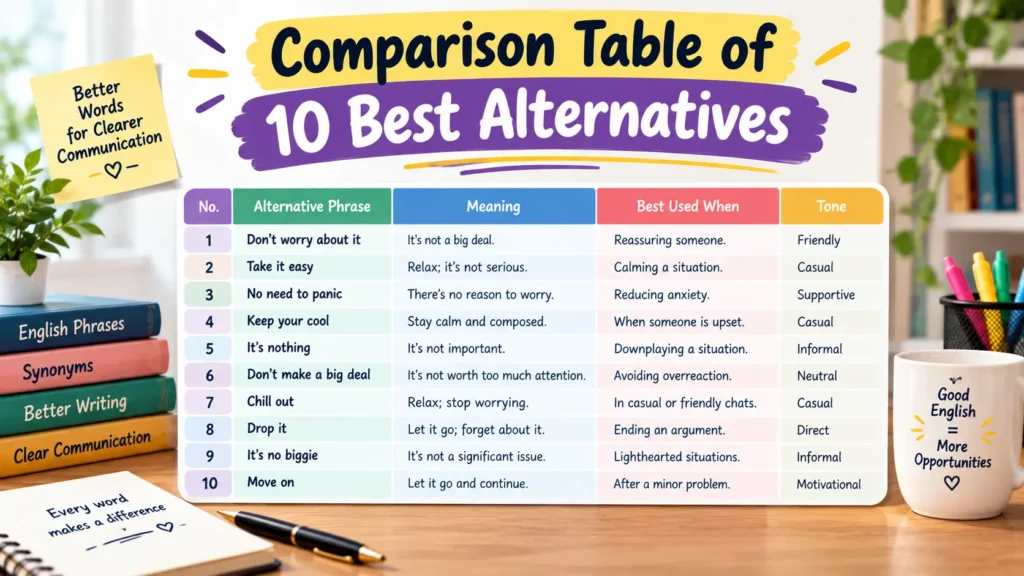
The following alternatives are especially useful because they cover different communication needs, from gentle correction to direct disagreement. Choose the wording according to how wrong the interpretation is, how formal the situation is, and how carefully you need to manage tone.
| Phrase | Meaning | Best Use | Worst Use | Tone | US vs UK Usage |
| That’s not quite right | The idea is inaccurate but may contain some truth. | Professional corrections | Serious factual disputes requiring strong wording | Polite, diplomatic | Common in both |
| That’s not what I meant | The speaker’s intended meaning was misunderstood. | Clarifying personal meaning | Correcting an external fact | Neutral, personal | Common in both |
| That’s not the case | A claim does not match reality. | Business and factual communication | Emotional disagreements | Professional, factual | Common in both |
| That’s not the point | The discussion is focusing on the wrong issue. | Meetings and debates | Sensitive personal conversations | Direct, firm | Common in both |
| That’s a different matter | The issue is separate from the current topic. | Analytical discussions | Simple misunderstandings | Controlled, neutral | Common in both |
| I think there may be a misunderstanding | Both sides may have interpreted something differently. | Conflict resolution | Urgent factual corrections | Diplomatic | Common in both |
| That’s not quite what I meant | The listener is close but has missed the intended meaning. | Collaboration and feedback | Completely unrelated interpretations | Gentle | Common in both |
| Let me clarify what I mean | The speaker is about to explain their intended message. | Presentations and emails | When a quick correction is enough | Cooperative | Common in both |
| You’ve got the wrong idea | Someone has formed an incorrect assumption. | Informal conversations | Formal workplace writing | Casual, direct | Common in both |
| That’s not even close | The interpretation is very far from reality. | Informal or playful settings | Sensitive or formal communication | Strong, casual | Common in both |
Conclusion:
“That Is Not It At All” is a clear and useful English expression for correcting a misunderstanding, rejecting an inaccurate assumption, or explaining that the real situation is different from what someone believes. Its meaning is straightforward, but its tone can change depending on the speaker, audience, and context. In casual conversations, it can sound natural and emphatic, while in professional or sensitive situations, softer alternatives such as “That’s not quite right,” “That’s not what I meant,” or “I think there may be a misunderstanding” may be more effective.
Understanding these alternatives helps ESL learners, students, professionals, writers, and everyday speakers communicate with greater precision. Rather than using the phrase automatically, consider what you are actually correcting: a fact, intention, interpretation, or point of discussion. Choosing the right expression makes communication clearer, more respectful, and more effective while helping prevent unnecessary confusion.
FAQs:
[faq_accordion]What does “That Is Not It At All” mean?
“That Is Not It At All” means that a suggested explanation, interpretation, assumption, or understanding is completely incorrect. It is often used when someone misunderstands another person’s intention or the real reason behind something. The phrase emphasizes that the proposed explanation is not accurate and that the actual situation is significantly different.
Is “That Is Not It At All” correct English?
Yes, “That Is Not It At All” is grammatically correct and natural English. In everyday conversation, the contracted version “That’s not it at all” is more common. The phrase uses “at all” to strengthen the negative meaning, indicating that the suggested idea is not correct in any meaningful way.
Is “That Is Not It At All” polite?
The phrase can be polite, but it is relatively direct. Its tone depends on context and delivery. In friendly conversation, it may sound completely natural. In sensitive or professional situations, alternatives such as “That’s not quite right” or “That’s not quite what I meant” can sound more diplomatic and less confrontational.
What is a polite alternative to “That Is Not It At All”?
A particularly polite alternative is “I think there may be a misunderstanding.” Other useful options include “That’s not quite right,” “That’s not quite what I meant,” and “Let me clarify.” These expressions correct the misunderstanding while maintaining a cooperative tone, making them useful in workplaces, customer communication, and sensitive conversations.
What is another way to say “That Is Not It At All”?
Depending on the context, you can say “That’s not quite right,” “That’s not what I meant,” “That’s not the case,” “That’s not the point,” “That’s a different matter,” or “There’s a misunderstanding.” Each alternative has a slightly different focus, so the best choice depends on whether you are correcting a fact, intention, interpretation, or topic.
Can I use “That Is Not It At All” in professional communication?
Yes, but use it thoughtfully. The phrase is understandable in professional communication, especially when speaking with familiar colleagues. However, formal emails and sensitive workplace discussions may benefit from softer wording. “That’s not quite what I meant” or “That’s not the case” can communicate the correction more professionally while reducing the risk of sounding dismissive.
What is the difference between “That’s not it” and “That’s not it at all”?
Both expressions reject an idea or interpretation, but “That’s not it at all” is stronger. The addition of “at all” emphasizes complete disagreement. “That’s not it” can sound brief and casual, while “That’s not it at all” makes it clearer that the proposed explanation is substantially or completely wrong.
Is “That Is Not It At All” common in American English?
Yes. “That Is Not It At All” and the more conversational “That’s not it at all” are understandable and natural in American English. American speakers may also use alternatives such as “That’s not what I meant,” “That’s not the point,” or “That’s not even close,” depending on how direct or casual they want to sound.
Is “That Is Not It At All” used in British English?
Yes, British English speakers also use the expression. There is no major grammatical difference between American and British English in this phrase. British speakers may sometimes favor softer expressions such as “That’s not quite right,” particularly in polite professional situations, but “That’s not it at all” remains perfectly understandable and natural.
When should I avoid saying “That Is Not It At All”?
Avoid it when the other person’s interpretation is partly correct, when the subject is highly sensitive, or when you need especially formal language. The phrase can sound overly absolute or direct in these situations. Consider “That’s not quite right,” “There’s another factor,” or “Let me clarify” when you want to preserve nuance and cooperation.
[/faq_accordion]