
The phrase “all bark, no bite” describes someone who threatens, sounds intimidating, or talks aggressively but never follows through. For example, a manager may repeatedly warn a team about consequences but never enforce them. In everyday English, this expression highlights the gap between words and actions.
Although the phrase is widely understood, it is informal and can sound dismissive in professional or sensitive situations. This guide explores its meaning, history, synonyms, tone, regional differences, and modern usage, along with 15 useful alternatives to help you choose the right expression for different contexts.
What Does “All Bark, No Bite” Mean?
“All bark, no bite” describes a person who makes strong, aggressive, or intimidating statements but does not follow through with meaningful action. The phrase is commonly used when someone threatens consequences, makes bold claims, or acts tough without demonstrating the ability or willingness to act. “All bark, no bite” therefore emphasizes a gap between words and actions.
Origin & History of “All Bark, No Bite”
The expression “all bark, no bite” comes from the image of a dog that barks loudly but never bites. The “bark” represents threats or aggressive words, while the “bite” symbolizes real action or consequences.
The phrase is related to the older proverb “his bark is worse than his bite,” which dates back to the 17th century. Over time, the modern version became widely used to describe people whose threats, promises, or aggressive words are not supported by their actions. Today, it commonly appears in everyday conversations, workplaces, online discussions, and politics.
Synonyms & Alternatives by Tone
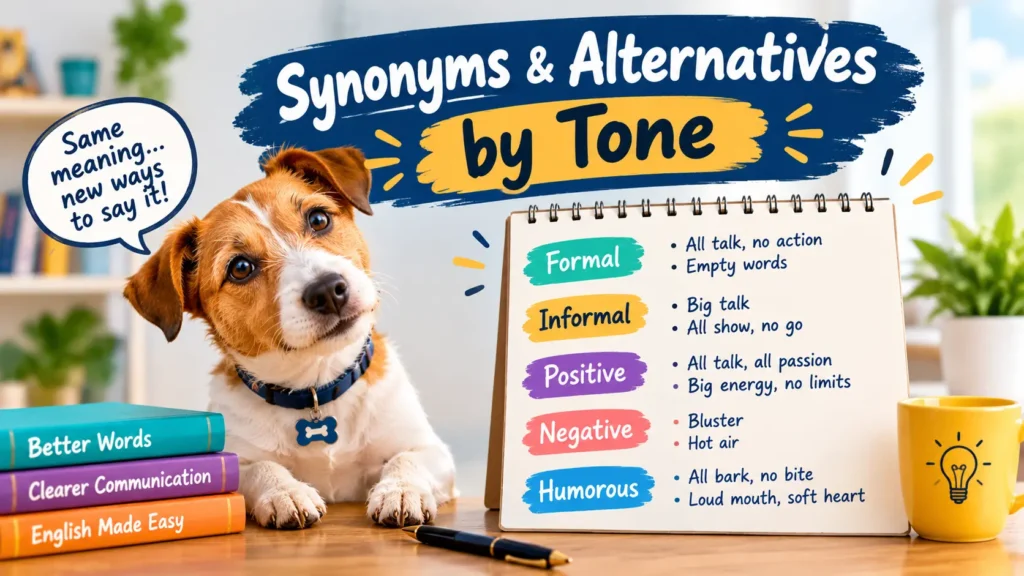
Professional & Neutral Alternatives
- All talk and no action
- No follow-through
- Fails to follow through
- Threat without follow-through
- More words than action
Polite & Supportive Alternatives
- Seems more intimidating than they are
- Their words are stronger than their actions
- May not act as strongly as they suggest
- Does not always follow through
- Their intentions may be stronger than their actions
Encouraging & Reassuring Alternatives
- His bark is worse than his bite
- They are not as intimidating as they seem
- The threat may not be as serious as it sounds
- They tend to talk tough
- The situation may be less serious than it appears
Casual, Playful & Idiomatic Alternatives
- All talk and no action
- Full of hot air
- Big talker
- Talks a big game
- Empty threats
- More noise than action
- A paper tiger
- Bluster without substance
When Should You Use “All Bark, No Bite”?
Professional Settings
Use the phrase carefully in professional communication. It can work in informal conversations between colleagues when discussing a person who repeatedly makes threats without acting.
For example, a colleague might privately say, “He keeps saying he will resign, but he is all bark and no bite.”
However, it is usually better to replace it with “there has been no follow-through” in formal reports, evaluations, or written feedback.
Casual Conversations
This is one of the phrase’s strongest settings. Friends and family members commonly use it to describe someone who sounds intimidating but rarely acts on their threats.
Writing and Presentations
The expression can make an article, presentation, speech, or opinion piece more conversational. It is particularly effective when the audience already understands common English idioms.
Digital Communication
It can appear naturally in social media posts, online discussions, text messages, and informal workplace chats. Because digital messages often lack facial expression and vocal tone, however, the phrase may sound harsher than intended.
When It Is Especially Effective
Use it when you want to highlight a clear contrast between threatening language and limited action. It is memorable, compact, and easy for most fluent English speakers to understand.
When Should You Avoid “All Bark, No Bite”?
Avoid the phrase when precision matters more than conversational impact.
Overly Formal Situations
A formal report, executive briefing, academic paper, or official complaint usually benefits from more precise language such as “the individual has not followed through on these commitments.”
Legal Contexts
Legal writing should identify specific actions, statements, obligations, and outcomes rather than relying on an idiom that could be interpreted differently by readers.
Academic Contexts
Academic writing generally favors direct descriptions. Instead of saying someone is “all bark, no bite,” explain that their stated intentions were not followed by corresponding actions.
Sensitive Situations
The expression can sound mocking or judgmental when discussing a person’s fears, workplace performance, conflict, or personal circumstances.
When Nuance May Be Lost
Someone may fail to act for many reasons besides weakness or dishonesty. They may lack authority, resources, information, time, or confidence. Calling them “all bark, no bite” can oversimplify the situation.
Is “All Bark, No Bite” Professional, Polite, or Casual?
“All bark, no bite” is primarily casual and idiomatic. It is understandable and widely recognizable, but it carries a judgmental undertone.
The phrase usually suggests that the speaker has evaluated someone’s behavior and concluded that the person is less powerful, dangerous, or effective than they appear.
Its emotional subtext can range from mildly teasing to openly dismissive.
For example:
- Casual: “Don’t worry about him. He’s all bark and no bite.”
- Workplace conversation: “She sounds pretty tough, but I think she’s all bark and no bite.”
- Formal alternative: “Her stated position has not been followed by corresponding action.”
The last version is more neutral because it describes observable behavior rather than labeling the person.
Pros and Cons of Using “All Bark, No Bite”
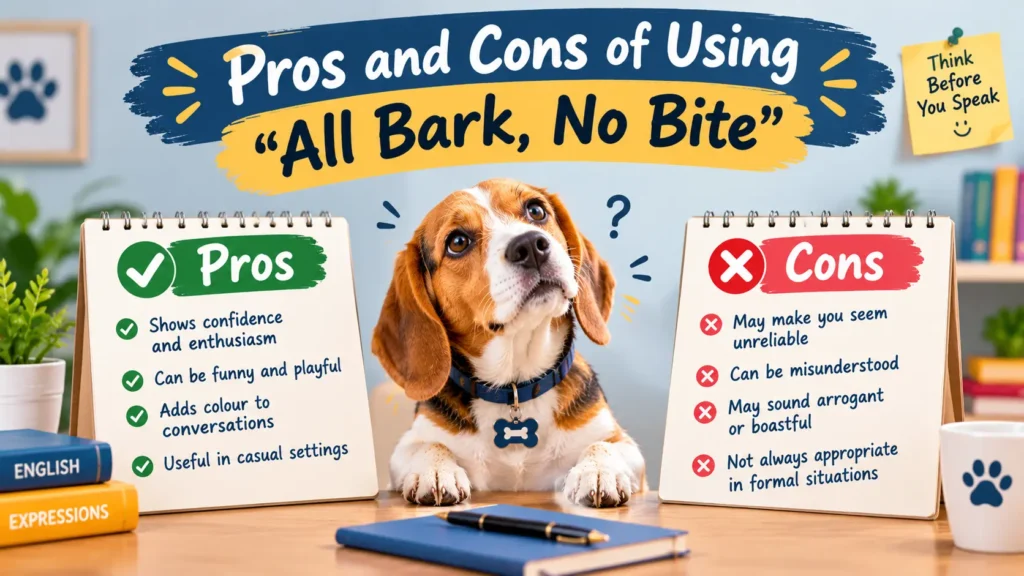
Advantages
- Clarity: It quickly communicates the difference between words and action.
- Efficiency: Five words can express a longer explanation.
- Accessibility: The meaning is familiar to many English speakers.
- Memorability: The animal-based contrast makes the expression easy to remember.
- Conversational appeal: It sounds natural in everyday English.
Potential Drawbacks
- Oversimplification: It may ignore legitimate reasons for someone’s lack of action.
- Tone mismatch: It can sound mocking or disrespectful.
- Repetition: Frequent use of idioms can make writing feel predictable.
- Informality: It is not ideal for every professional context.
- Personal judgment: It labels a person rather than describing a specific behavior.
Real-Life Examples of “All Bark, No Bite” by Context
“I wouldn’t worry too much about the latest threat. He has made similar comments before and never followed through. At this point, he seems all bark and no bite.”
This works in an informal internal email but would be inappropriate in a formal disciplinary record.
Meetings
“We’ve heard several strong objections, but so far there hasn’t been any action behind them.”
This is generally better than saying someone is “all bark and no bite” during a formal business meeting.
Presentations
“The campaign sounded aggressive, but the organization ultimately took very few concrete steps.”
This communicates the same basic idea while remaining professional.
Conversations
“Don’t let him scare you. He’s all bark and no bite.”
This is a natural conversational use because the speaker is reassuring another person.
Social Media
“Lots of big threats, zero follow-through. All bark, no bite.”
The shortened construction works well in informal online writing because it is punchy and recognizable.
“All Bark, No Bite” vs Similar Expressions: Key Differences
| Phrase | Meaning Difference | Tone Difference | Best Use Scenario |
| All talk and no action | Emphasizes talking without doing | Neutral to casual | Workplace discussions and everyday conversation |
| His bark is worse than his bite | Suggests someone sounds harsher than they really are | Reassuring, conversational | Describing a seemingly intimidating person |
| Empty threats | Focuses specifically on threats that are unlikely to be carried out | Direct and somewhat negative | Conflicts, warnings, and commentary |
| Full of hot air | Suggests someone talks excessively without substance | Casual, dismissive | Informal conversation |
| Paper tiger | Describes something that appears powerful but is actually weak or ineffective | Figurative, analytical | Politics, organizations, institutions, and strategy |
| Talks a big game | Focuses on confident claims that may exceed actual ability | Casual, sometimes playful | Sports, business, personal claims |
The key distinction is that “all bark, no bite” specifically combines intimidating communication with a lack of action. “All talk and no action” is broader, while “paper tiger” focuses more on apparent power than threatening language.
Common Mistakes & Misuse of “All Bark, No Bite”
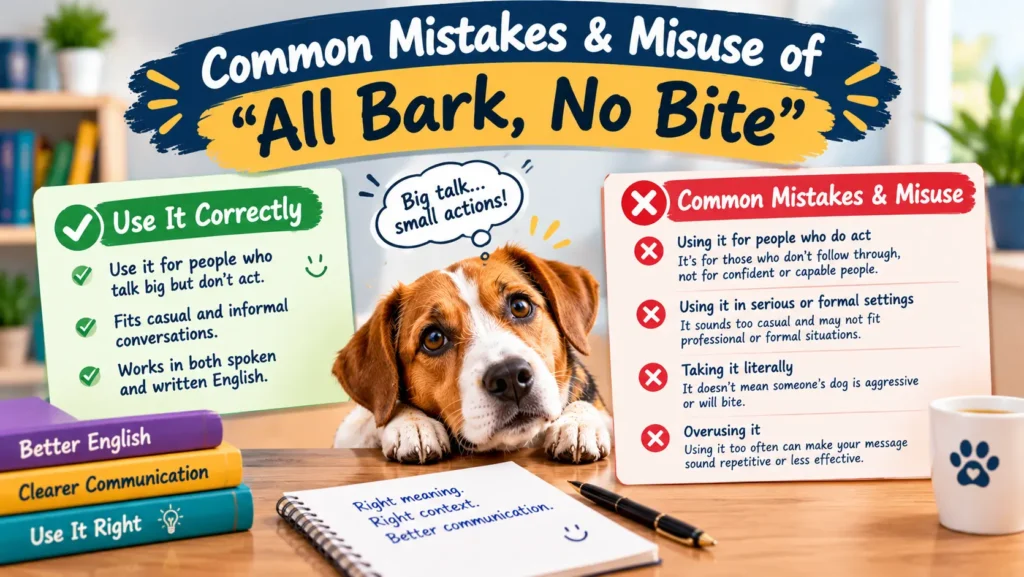
Overuse
Using the phrase repeatedly can make writing sound formulaic. Rotate it with alternatives such as “no follow-through,” “empty threats,” or “all talk and no action.”
Incorrect Context
Do not automatically use it whenever someone fails to complete a task. The expression usually carries an element of strong talk, intimidation, boasting, or threats.
For example, someone who simply forgets to submit a report is not necessarily “all bark and no bite.”
Contradictory Usage
The phrase does not normally describe someone who makes few statements but takes decisive action. In that situation, expressions such as “actions speak louder than words” are more appropriate.
Cultural Misunderstandings
Idioms can be difficult for ESL learners because their literal meaning does not explain their intended meaning. A learner may interpret “bark” and “bite” literally instead of recognizing the expression as a figurative description of behavior.
Psychological Reasons People Prefer “All Bark, No Bite”
Cognitive Load Reduction
Idioms compress a longer explanation into a familiar phrase. Instead of saying, “This person repeatedly makes intimidating statements but does not take corresponding action,” a speaker can say, “He’s all bark and no bite.”
Trust and Authority Signals
The expression can also communicate the speaker’s judgment quickly. It signals that the speaker believes they have noticed a pattern between someone’s words and behavior.
Attention Economy
Modern communication rewards concise language. Short expressions are especially useful in chats, social posts, headlines, and informal commentary.
Modern Communication Habits
People increasingly communicate through short messages where context is limited. Familiar expressions can efficiently communicate attitudes, although they can also create ambiguity when the audience is unfamiliar with the idiom.
US vs UK Usage of “All Bark, No Bite”
The expression is understood in both American and British English. There is no strong meaning difference between the two varieties.
The related expression “his bark is worse than his bite” has a long history in British English and remains recognizable in both regions.
In both the US and UK, “all bark and no bite” is generally informal and conversational.
American speakers may use it freely in workplace conversations, sports discussions, social media, and everyday speech. British speakers also understand it, although “his bark is worse than his bite” can sometimes feel more traditional.
The difference is therefore more about preference and context than meaning.
“All Bark, No Bite” in Digital & Modern Communication
Emails
In informal internal communication, the phrase can add personality. In formal emails, replace it with an observable description such as “there has been no follow-through.”
Slack and WhatsApp
Short-form messaging is a natural environment for idiomatic language:
“He keeps threatening to leave the project 😂. Definitely all bark, no bite.”
The casual environment makes the expression feel more natural.
Social Media
The phrase is popular because it is short, expressive, and easy to understand:
“Big statements. No action. All bark, no bite.”
It can also sound confrontational, so writers should consider whether they want to criticize someone publicly.
AI-Generated Summaries
AI-generated summaries should generally translate the idiom into direct language when the audience needs maximum clarity. For example, “The speaker made strong threats but did not follow through” is more precise than simply repeating the idiom.
All Talk and No Action
Meaning: This phrase describes someone who talks about intentions, plans, or promises but does not take corresponding action.
Why This Phrase Works: It is one of the closest neutral alternatives to “all bark and no bite.” It removes the aggressive dog imagery while preserving the central contrast between words and behavior.
Real-World Usage Insight: This expression is especially useful when the issue is inaction rather than intimidation.
Best Use: Workplace conversations, performance discussions, project updates, and everyday speech.
Avoid When: You specifically need to emphasize threats or intimidating behavior.
Tone: Neutral, direct, and conversational.
US vs UK Usage: Common and easily understood in both American and British English.
Example (Meeting): “We’ve talked about improving the onboarding process for three months, but we’re still all talk and no action. Can we agree on two specific changes today?”
No Follow-Through
Meaning: “No follow-through” means that someone does not complete or act on what they previously said, promised, or started.
Why This Phrase Works: It focuses on behavior instead of personality, making it particularly useful in professional communication.
Real-World Usage Insight: Managers and colleagues can use this wording when discussing commitments without sounding unnecessarily personal.
Best Use: Workplace feedback, project management, professional emails, and performance discussions.
Avoid When: You want a playful or strongly idiomatic expression.
Tone: Professional, neutral, and evidence-focused.
US vs UK Usage: Natural in both varieties of English.
Example (Email): “We agreed on the revised timeline last Monday, but there has been no follow-through on the outstanding tasks. Could we confirm who owns each item?”
Empty Threats
Meaning: “Empty threats” refers to threats that are not supported by an intention or ability to act.
Why This Phrase Works: It directly identifies the threatening element of “all bark, no bite.”
Real-World Usage Insight: The phrase is stronger than “no follow-through” because it suggests that the speaker’s warning has little credibility.
Best Use: Informal discussions, conflict commentary, and situations involving repeated warnings.
Avoid When: You cannot establish whether a threat is actually empty.
Tone: Direct, skeptical, and somewhat negative.
US vs UK Usage: Common in both American and British English.
Example (Social Media): “After three posts promising a lawsuit and no actual filing, people have started treating the warnings as empty threats.”
His Bark Is Worse Than His Bite
Meaning: This expression suggests that someone sounds frightening, angry, or aggressive but is less harmful or severe than their words suggest.
Why This Phrase Works: It is historically connected to the same dog-based image and often reassures listeners that the person is not as dangerous as they appear. Cambridge gives the phrase essentially this meaning: frightening words are not matched by equally severe actions.
Real-World Usage Insight: Unlike “all bark, no bite,” this expression can be sympathetic rather than critical.
Best Use: Describing a stern boss, teacher, parent, coach, or intimidating personality.
Avoid When: The person has made a genuinely credible threat.
Tone: Reassuring, idiomatic, and conversational.
US vs UK Usage: Widely understood in both regions; it has particularly strong historical roots in British English.
Example (Conversation): “Don’t take the new supervisor personally. His bark is worse than his bite, and once you talk to him, he’s actually quite reasonable.”
Full of Hot Air
Meaning: “Full of hot air” describes someone who talks a lot without saying anything substantial or producing meaningful results.
Why This Phrase Works: It is useful when the problem is exaggerated claims, empty discussion, or boasting rather than direct threats.
Real-World Usage Insight: The expression is more dismissive than “no follow-through” and can sound humorous in casual settings.
Best Use: Informal conversations, commentary, and discussions about exaggerated claims.
Avoid When: Giving sensitive professional feedback.
Tone: Casual, humorous, and dismissive.
US vs UK Usage: Common in both American and British English.
Example (Meeting): “He spent twenty minutes promising a complete turnaround, but when we asked for numbers, there was nothing. It sounded like a lot of hot air.”
Talks a Big Game
Meaning: “Talks a big game” describes someone who speaks confidently about their abilities, plans, or intentions, sometimes more confidently than their performance justifies.
Why This Phrase Works: It is especially useful when someone boasts about what they can do rather than directly threatening someone.
Real-World Usage Insight: The phrase is common in sports and has spread into business, work, and everyday conversation.
Best Use: Sports, business, skills, competition, and casual conversation.
Avoid When: Writing formal evaluations or objective reports.
Tone: Casual, lively, and slightly skeptical.
US vs UK Usage: Widely understood, with particularly strong familiarity in American English.
Example (Conversation): “He talks a big game about coding, but when the team needs help fixing a bug, he usually disappears.”
Paper Tiger
Meaning: A “paper tiger” is a person, organization, or institution that appears powerful or threatening but is actually weak or ineffective.
Why This Phrase Works: It shifts the focus from threatening words to the gap between apparent power and actual power.
Real-World Usage Insight: The expression works especially well when discussing organizations, political actors, policies, or institutions.
Best Use: Analysis, commentary, strategy, politics, and business.
Avoid When: You need to describe ordinary personal boasting.
Tone: Figurative, analytical, and somewhat critical.
US vs UK Usage: Recognizable in both American and British English.
Example (Blog): “The company looked unbeatable from the outside, but its repeated failures to deliver suggested that its market dominance was more paper tiger than reality.”
More Words Than Action
Meaning: “More words than action” describes a person or organization whose communication substantially exceeds its practical results.
Why This Phrase Works: It communicates the central idea without the mocking quality of some idioms.
Real-World Usage Insight: This is a useful bridge between conversational and professional English.
Best Use: Presentations, articles, workplace discussions, and constructive criticism.
Avoid When: You need to specifically describe threats.
Tone: Neutral, measured, and slightly critical.
US vs UK Usage: Natural in both varieties.
Example (Meeting): “The proposal has generated a lot of discussion, but so far we’ve seen more words than action. Let’s agree on a deadline.”
Threat Without Follow-Through
Meaning: This phrase identifies a threat that is made but not subsequently acted upon.
Why This Phrase Works: It is precise and removes the informal imagery of the original idiom.
Real-World Usage Insight: The wording is especially helpful when documenting a pattern objectively.
Best Use: Professional discussions, reports, analysis, and serious conversations.
Avoid When: You want a relaxed, humorous expression.
Tone: Formal, precise, and neutral.
US vs UK Usage: Clear and natural in both American and British English.
Example (Email): “The supplier has issued several warnings about cancellation, but each has remained a threat without follow-through.”
They Talk Tough
Meaning: “They talk tough” means someone uses language intended to sound strong, confident, aggressive, or intimidating.
Why This Phrase Works: It describes the person’s communication without automatically claiming that they are incapable of acting.
Real-World Usage Insight: This is useful when you want to remain slightly cautious about judging the person’s actual intentions.
Best Use: Informal conversations, interviews, social commentary, and everyday speech.
Avoid When: You need to document whether an actual threat was carried out.
Tone: Casual, observational, and mildly skeptical.
US vs UK Usage: Understood in both regions, with particularly natural usage in American conversational English.
Example (Conversation): “He talks tough when everyone is in the room, but he becomes much more reasonable when you discuss the issue privately.”
Bluster Without Substance
Meaning: This phrase describes forceful or confident language that lacks meaningful evidence, support, or action.
Why This Phrase Works: It is more analytical than “all bark, no bite” and works well when evaluating arguments or public statements.
Real-World Usage Insight: It is particularly suitable when the concern is not merely inaction but the absence of credible substance.
Best Use: Articles, presentations, business analysis, and commentary.
Avoid When: Speaking casually with young children or beginner English learners who may not know “bluster.”
Tone: Analytical, critical, and moderately formal.
US vs UK Usage: Understandable in both varieties.
Example (Blog): “The announcement sounded impressive at first, but investors quickly noticed that it contained more bluster without substance than concrete plans.”
More Noise Than Action
Meaning: “More noise than action” describes a situation where there is considerable discussion, controversy, or attention but little practical progress.
Why This Phrase Works: It can describe individuals, teams, campaigns, or entire situations rather than only one person’s threats.
Real-World Usage Insight: It is useful when you want to criticize ineffective activity without directly attacking someone’s character.
Best Use: Workplace discussions, news commentary, project reviews, and social media.
Avoid When: You need to identify a specific threat.
Tone: Conversational, critical, and relatively accessible.
US vs UK Usage: Easily understood in both American and British English.
Example (Meeting): “We’ve had three strategy meetings and dozens of messages, but the project is still in the same place. Right now, it’s more noise than action.”
Comparison Table of 10 Best Alternatives

The best substitute depends on what you want to emphasize: inaction, empty threats, excessive confidence, lack of substance, or apparent weakness. The table below highlights the most practical options for everyday and professional English.
| Phrase | Meaning | Best Use | Worst Use | Tone | US vs UK Usage |
| All Talk and No Action | Words without corresponding action | Everyday and workplace discussion | Precise legal writing | Neutral, casual | Common in both |
| No Follow-Through | Failure to complete a commitment | Professional communication | Playful conversation | Professional, neutral | Common in both |
| Empty Threats | Threats unlikely to be carried out | Conflict and warnings | Sensitive workplace feedback | Direct, negative | Common in both |
| His Bark Is Worse Than His Bite | Sounds harsher than actual behavior | Reassurance and casual speech | Genuine threats | Reassuring, idiomatic | Common in both |
| Full of Hot Air | Lots of talk without substance | Informal commentary | Formal reports | Casual, dismissive | Common in both |
| Talks a Big Game | Makes confident claims about ability | Sports and casual speech | Academic writing | Casual, playful | Strongly familiar in US; understood in UK |
| Paper Tiger | Appears powerful but is actually weak | Analysis and commentary | Ordinary personal disagreements | Figurative, analytical | Common in both |
| More Words Than Action | Communication exceeds results | Workplace and presentations | Direct threat situations | Measured, critical | Common in both |
| Threat Without Follow-Through | A threat is made but not acted upon | Formal analysis | Friendly conversation | Precise, formal | Clear in both |
| Fails to Follow Through | Does not complete a stated commitment | Professional feedback | Humorous social posts | Neutral, constructive | Common in both |
Conclusion:
“All bark, no bite” is a common English idiom describing someone whose threatening or confident words are not supported by action. It is often used in everyday conversations, social media, and informal workplace discussions, but it can sound judgmental in formal or sensitive situations.
In professional communication, alternatives such as “no follow-through” or “more words than action” may sound more appropriate. Understanding this idiom helps ESL learners recognize how English expressions communicate meanings beyond their literal words and choose suitable language for different contexts.
FAQs:
[faq_accordion]What does “all bark, no bite” mean?
“All bark, no bite” describes someone who sounds threatening or confident but does not take action. It is commonly used in informal conversations.
Is “all bark, no bite” a negative phrase?
Yes, it can sound critical because it suggests someone’s words are not supported by action. However, it can also be used playfully.
What is the best synonym for “all bark, no bite”?
“All talk and no action” is the closest synonym. Other alternatives include “empty threats,” “no follow-through,” and “talks a big game.”
Is “all bark, no bite” professional?
It is mainly informal and may sound judgmental at work. More professional alternatives include “no follow-through” and “fails to follow through.”
What is the opposite of “all bark, no bite”?
Opposites include “walks the talk,” “follows through,” and “actions speak louder than words.” These describe people whose actions match their words.
Can “all bark, no bite” describe a company?
Yes, it can describe a company that makes promises or announcements without taking action. In business writing, “limited follow-through” sounds more professional.
What is the difference between “all bark, no bite” and “empty threats”?
“All bark, no bite” describes intimidating words without meaningful action, while “empty threats” specifically refers to threats that are unlikely to be carried out.
Can I use “all bark, no bite” in an email?
Yes, in casual emails. For formal communication, use “there has been no follow-through” to maintain a neutral tone.
Is “all bark, no bite” used in American and British English?
Yes, the expression is understood in both American and British English, with essentially the same meaning.
How can ESL learners use “all bark, no bite” correctly?
Use it in informal conversations when someone’s threatening words are not supported by action. In formal writing, “no follow-through” is usually more appropriate.
[/faq_accordion]SEO Meta Description
All Bark, No Bite meaning, synonyms, examples, tone, origin, and alternatives explained clearly for everyday, professional, and ESL communication.