
Imagine your team has finally fixed a difficult software bug, your presentation is ready, and someone says, “Looks like everything is going perfectly now.” A colleague quickly replies, “Don’t jinx it.” Everyone understands the point: things are going well, so there is a playful fear that talking too confidently about the outcome might somehow bring bad luck.
“Don’t jinx it” is a common informal English expression used when someone mentions a positive expected outcome before it is certain. The phrase is closely connected with superstition, humor, caution, and everyday conversation. It can be heard among students waiting for exam results, professionals discussing a successful project, sports fans watching a derstanding this phrase is useful for ESL learners, writers, professionals, and anyone who wants to wish for a good outcome, or friends hoping that travel plans go smoothly.
What Does “Don’t Jinx It” Mean?
“Don’t jinx it” means “don’t say or assume that something good will happen because you might supposedly cause the expected positive outcome to fail.” It is an informal expression tied to superstition. It is commonly used when discussing uncertain results, plans, competitions, exams, relationships, work projects, travel, or other situations that are going well.
Origin & History of “Don’t Jinx It”

The keyword in the expression is “jinx.” Modern dictionaries define jinx as a person, thing, or influence believed to bring bad luck, and as a verb meaning to cause bad luck or interfere with a desired outcome. Cambridge also labels the verb as informal and gives examples involving someone avoiding a positive prediction because they do not want to “jinx” the result.
The exact history of jinx is not completely certain. Collins dates the American English noun and verb to the early 20th century and connects the word, with some uncertainty, to jynx, the Latin/Greek name for the wryneck bird, which was associated with magic and divination. Collins places the modern American use around 1910–15.
The word gradually developed a broader everyday meaning. Instead of referring only to a supposedly unlucky person or influence, to jinx something came to mean causing an anticipated success to fail, often simply by talking about it too confidently.
That development explains the modern expression “Don’t jinx it.” The phrase does not normally express a serious belief in supernatural forces. In contemporary English, it is frequently playful, humorous, or mildly superstitious. Someone might say it after a confident prediction such as, “We haven’t lost a game all season,” or “The flight is definitely going to be on time.”
Synonyms & Alternatives by Tone
Professional & Neutral Alternatives
- Let’s not assume it yet.
- Let’s wait and see.
- Let’s not get ahead of ourselves.
- The outcome isn’t certain yet.
- Let’s not count on it just yet.
Polite & Supportive Alternatives
- Hopefully, it stays that way.
- Let’s hope everything continues smoothly.
- I hope it works out.
- Let’s keep our expectations measured.
- Hopefully, there are no surprises.
Encouraging & Reassuring Alternatives
- Fingers crossed.
- I’m keeping my fingers crossed.
- Let’s hope for the best.
- Hopefully, everything goes according to plan.
- I think we’re in a good position.
Casual, Playful & Idiomatic Alternatives
- Don’t tempt fate.
- Knock on wood.
- Touch wood.
- Let’s not celebrate too soon.
- Better not say it out loud.
- Don’t count your chickens before they hatch.
- Let’s not spoil it.
- We’ll see how it goes.
- Don’t speak too soon.
- Let’s not tempt the universe.
When Should You Use “Don’t Jinx It”?
“Don’t jinx it” works best when the situation is informal, and the outcome is uncertain. It is especially natural when people are talking about something positive that they hope will continue.
Professional settings
Use it selectively with colleagues you know well. For example:
“The client has approved every revision so far.”
A teammate might reply:
“Don’t jinx it 6we still have the final review tomorrow.”
This can sound friendly and natural in a relaxed workplace. However, it is less suitable in a formal report or communication with a client.
Casual conversations
This is where the expression is most comfortable. Friends and family commonly use it when discussing exams, sports, travel, relationships, weather, money, or plans.
Writing, presentations, and digital communication
The phrase works well in social posts, informal blogs, chats, captions, and conversational writing. In professional writing, alternatives such as “Let’s wait and see” or “The outcome is not certain yet” are usually clearer.
When it is especially effective
Use it when you want to communicate caution without sounding serious or negative. It allows someone to acknowledge a positive situation while avoiding an overly confident prediction.
When Should You Avoid “Don’t Jinx It”?
There are several situations where a more precise expression is preferable.
Overly formal situations
In official reports, business proposals, academic papers, and formal presentations, “don’t jinx it” can sound too conversational.
Instead of:
“The results look great, so don’t jinx it.”
Use:
“The results are encouraging, but the outcome remains uncertain.”
Legal, academic, or sensitive contexts
Legal and academic communication generally benefits from precise statements rather than expressions based on superstition.
For example, a legal document should not use jinx to describe a possible outcome. The writer should clearly state what is known, unknown, expected, or conditional.
Situations where nuance may be lost
Some ESL learners may interpret jinx literally as “cause bad luck.” Native speakers often use it humorously. If your audience may not understand the idiom, use a straightforward alternative.
Is “Don’t Jinx It” Professional, Polite, or Casual?
“Don’t jinx it” is primarily casual and informal. Cambridge specifically identifies jinx as an informal verb.
Its emotional subtext is usually light. The speaker is rarely accusing another person of genuinely causing supernatural harm. Instead, the phrase communicates something closer to:
“Things are going well, so let’s not become too confident before we know the result.”
In a workplace, perception depends heavily on the relationship between speakers. Among close colleagues, it can create friendliness and shared humor. In a formal meeting with senior leadership or an external client, however, it may sound overly casual.
For ESL learners, the safest rule is simple:
Use “don’t jinx it” in conversation and informal digital communication; use clearer, neutral alternatives in formal professional writing.
Pros and Cons of Using “Don’t Jinx It”
Advantages
- Clarity: Native speakers usually understand the intended meaning immediately.
- Efficiency: Three short words communicate caution, uncertainty, and humor.
- Accessibility: It is common in everyday conversational English.
- Social connection: It can create a relaxed sense of shared understanding.
- Emotional balance: It acknowledges optimism without sounding excessively confident.
Potential Drawbacks
- Oversimplification: It may reduce a complex uncertainty to a playful superstition.
- Tone mismatch: It can sound too casual in formal situations.
- Repetition: Frequent use can make speech sound predictable.
- Cultural confusion: Some learners may interpret it literally.
- Reduced precision: It does not explain the actual reason an outcome remains uncertain.
Real-Life Examples of “Don’t Jinx It” by Context
Emails
Informal workplace email:
“The client has already approved the first three stages, so hopefully we’re nearly there. Don’t jinx it, though we still need the final sign-off.”
Meetings
“The new process has reduced the number of support tickets this month.”
“That’s great. Don’t jinx it; we still have two weeks left.”
Presentations
A presenter discussing early project results might say:
“The first month has gone extremely well, but I don’t want to jinx it. We’ll need another quarter of data before concluding.”
Conversations
“I think I finally passed my driving test.”
“Don’t jinx it! Wait until you get the official result.”
Social media
“Three flights this year and not a single delay. Don’t jinx it.”
This use is especially natural because social media favors short, conversational expressions.
“Don’t Jinx It” vs Similar Expressions
The alternatives below are related, but they are not perfect synonyms. Some express superstition, while others simply communicate caution or uncertainty.
| Phrase | Meaning Difference | Tone Difference | Best Use Scenario |
| Don’t tempt fate | Avoid doing something that could invite bad luck or an unwanted result. | Casual, slightly dramatic | When someone is being overly confident |
| Fingers crossed | Expresses hope that something will go well. | Casual, optimistic | Waiting for an uncertain result |
| Knock on wood | A traditional response meant to avoid bad luck after mentioning good fortune. | Casual, superstitious | After making a positive statement |
| Let’s wait and see | Avoids predicting until more information is available. | Neutral, professional | Business, school, decisions |
| Don’t get ahead of yourself | Warns someone not to assume success too early. | Direct, practical | Work, planning, decision-making |
| Don’t count your chickens before they hatch | Warns against treating an expected result as certain. | Idiomatic, conversational | Plans, money, achievements |
Psychological Reason People Prefer “Don’t Jinx It”
People use expressions such as “don’t jinx it” partly because they make uncertainty easier to handle socially.
Cognitive load reduction
Instead of explaining a long thought such as:
“I know the situation looks promising, but several variables could still change the outcome.”
a speaker can simply say:
“Don’t jinx it.”
The short expression compresses a familiar social idea into a few words.
Trust and authority signals
In informal groups, shared expressions can signal familiarity. Someone who uses the phrase naturally may sound comfortable with conversational English and the social expectations of the group.
Attention economy
Modern communication rewards short expressions. A three-word phrase can communicate caution without interrupting the flow of a conversation.
Modern communication habits
Chats, messaging apps, workplace platforms, and social media encourage concise language. Expressions such as “don’t jinx it,” “fingers crossed,” and “let’s wait and see” fit naturally into this environment.
US vs UK Usage of “Don’t Jinx It”
“Jinx” is understood in both American and British English. Cambridge provides pronunciation and definitions for both varieties, while Collins also lists British and American forms.
The pronunciation is essentially the same, and the core meaning is shared. The bigger difference is not whether the expression is understood but how frequently a particular speaker chooses it.
In American English, “don’t jinx it” is particularly familiar in sports, everyday conversation, entertainment, and informal workplace speech.
British English speakers also understand and use jinx, while expressions such as “touch wood” can be particularly recognizable in British conversational contexts.
There is no major grammatical difference between US and UK English for the expression. The main consideration is register: it remains informal in both varieties.
“Don’t Jinx It” in Digital & Modern Communication
Emails
In an informal internal email, it can add personality:
“Everything is looking good for Friday. Don’t jinx it, but I think we’re finally finished.”
For external clients, a neutral alternative is safer.
Slack / WhatsApp
The phrase fits naturally into quick messages:
“The server has been stable all morning.”
“Don’t jinx it 😂”
This is a typical example of how the expression can become even more playful through emojis.
Social media
The phrase works well in short posts because it communicates optimism and caution at the same time.
“Finally booked the trip. Everything is sorted. Don’t jinx it.”
AI-generated summaries
AI-generated professional summaries generally benefit from replacing informal idioms with explicit language. Instead of summarizing a discussion as:
“The team hopes the launch goes well but doesn’t want to jinx it.”
a formal summary might say:
“The team is optimistic about the launch but recognizes that the outcome remains uncertain.”
The second version is more precise and easier to interpret across professional audiences.
Meaning, Usage & Examples for Each Alternative
Don’t Tempt Fate
Meaning: “Don’t tempt fate” means do not behave as though an uncertain positive outcome is guaranteed or deliberately take a risk that could lead to trouble. It is closely related to “don’t jinx it,” but it can sound slightly more dramatic and can apply to risky actions as well as words.
Why This Phrase Works: It clearly communicates caution while preserving the playful idea that excessive confidence can invite an unwanted outcome.
Real-World Usage Insight: Native speakers often use it when someone is becoming too confident about a situation that could still change.
Best Use: Casual conversations, sports, travel, plans, and informal workplace conversations.
Avoid When: Writing formal reports or communicating technical risk.
Tone: Casual, cautionary, slightly dramatic.
US vs UK Usage: Common and understood in both varieties of English.
Example (Meeting): “The new process has worked perfectly for three weeks, but don’t tempt fate—we should keep monitoring it.”
Fingers Crossed
Meaning: “Fingers crossed” expresses hope that something will have a positive outcome. Unlike “don’t jinx it,” it focuses more on hope than on avoiding bad luck.
Why This Phrase Works: It is short, friendly, and optimistic without requiring a long explanation.
Real-World Usage Insight: It frequently appears when people are waiting for news, approval, results, or confirmation.
Best Use: Messages, conversations, social media, informal emails.
Avoid When: A highly formal or evidence-based statement is required.
Tone: Hopeful, friendly, casual.
US vs UK Usage: Widely understood in both US and UK English.
Example (Email): “The application has moved to the final stage. Fingers crossed we hear back by Friday.”
Knock on Wood
Meaning: “Knock on wood” is used after mentioning good luck or a positive situation to avoid supposedly attracting bad luck. It is a more specific superstition-related expression than “don’t jinx it.”
Why This Phrase Works: It directly responds to the idea that mentioning good fortune could reverse it.
Real-World Usage Insight: Speakers may literally tap a wooden surface after saying it, although the physical action is not always performed.
Best Use: Casual conversation and humorous situations.
Avoid When: Formal professional or academic writing.
Tone: Playful, superstitious, informal.
US vs UK Usage: Common in American English; British speakers may also understand it, though “touch wood” is a familiar British alternative.
Example (Conversation): “My car has been running perfectly for months, knock on wood.”
Let’s Wait and See
Meaning: “Let’s wait and see” means that the speaker does not want to make a conclusion before enough information is available.
Why This Phrase Works: It removes the supernatural element completely and replaces it with practical caution.
Real-World Usage Insight: This is one of the safest alternatives when speaking to mixed audiences or people who may not understand idioms.
Best Use: Workplace conversations, meetings, academic discussions, and everyday speech.
Avoid When: You specifically want a playful or humorous response.
Tone: Neutral, calm, professional.
US vs UK Usage: Natural in both varieties.
Example (Meeting): “The early numbers look promising, but let’s wait and see what the full quarter tells us.”
Don’t Get Ahead of Yourself
Meaning: “Don’t get ahead of yourself” means do not assume success or make plans based on an outcome that has not happened yet.
Why This Phrase Works: It directly addresses premature confidence.
Real-World Usage Insight: The expression can be useful when someone is already planning the next step before the current step is confirmed.
Best Use: Work, school, planning, competitions, and decision-making.
Avoid When: Speaking to someone who may perceive direct caution as criticism.
Tone: Direct, practical, moderately informal.
US vs UK Usage: Common and natural in both.
Example (Conversation): “You might get the promotion, but don’t get ahead of yourself—we haven’t heard from HR yet.”
Hopefully, It Stays That Way
Meaning: This phrase expresses hope that a positive situation will continue.
Why This Phrase Works: It is supportive rather than corrective, so it can sound gentler than “don’t jinx it.”
Real-World Usage Insight: It works well when someone has just mentioned an improvement or successful period.
Best Use: Conversations, informal messages, and friendly workplace communication.
Avoid When: You need to clearly explain a specific risk.
Tone: Warm, positive, cautious.
US vs UK Usage: Natural in both varieties.
Example (Email): “The system has been stable since yesterday. Hopefully, it stays that way through the weekend.”
Don’t Count Your Chickens Before They Hatch
Meaning: This idiom warns people not to assume that expected benefits or successes will definitely happen before they actually occur.
Why This Phrase Works: It strongly emphasizes the difference between expectation and confirmed reality.
Real-World Usage Insight: It is more idiomatic and old-fashioned than “don’t jinx it,” so it may sound less natural in some modern professional conversations.
Best Use: Informal advice, planning, financial discussions, and casual conversation.
Avoid When: You need concise, modern professional wording.
Tone: Traditional, idiomatic, mildly humorous.
US vs UK Usage: Understood in both American and British English.
Example (Conversation): “We may have several new customers next month, but don’t count your chickens before they hatch.”
Don’t Speak Too Soon
Meaning: “Don’t speak too soon” means avoid making a confident statement before an uncertain result has been decided.
Why This Phrase Works: It closely matches the practical meaning of “don’t jinx it” while being easier to understand literally.
Real-World Usage Insight: It is particularly common when events are still unfolding.
Best Use: Sports, competitions, interviews, negotiations, and everyday conversation.
Avoid When: The outcome is already confirmed.
Tone: Casual, cautionary, concise.
US vs UK Usage: Natural in both varieties.
Example (Social Media): “We’re up by two goals with five minutes left. Don’t speak too soon.”
Let’s Not Assume It Yet
Meaning: This phrase tells someone not to treat an uncertain result as fact.
Why This Phrase Works: It is straightforward and removes the superstition associated with “jinx.”
Real-World Usage Insight: This is a strong choice for professional communication because the meaning is explicit.
Best Use: Meetings, project discussions, academic work, and business communication.
Avoid When: You are deliberately trying to sound playful.
Tone: Neutral, measured, professional.
US vs UK Usage: Standard in both varieties.
Example (Meeting): “The client seems interested, but let’s not assume it yet. We still need written confirmation.”
Better Not Say It Out Loud
Meaning: “Better not say it out loud” suggests that mentioning a hoped-for outcome might somehow cause it not to happen.
Why This Phrase Works: It preserves the playful superstition behind “don’t jinx it” while sounding natural and conversational.
Real-World Usage Insight: Speakers often use it after making or considering a positive prediction.
Best Use: Friends, family, informal chats, and humorous workplace conversations.
Avoid When: Writing formal or technical documents.
Tone: Playful, superstitious, informal.
US vs UK Usage: Easily understood in both varieties.
Example (Conversation): “We might actually finish early today. Better not say it out loud.”
Let’s Not Spoil It
Meaning: “Let’s not spoil it” can mean avoiding behavior or discussion that might interfere with an enjoyable or promising situation. Depending on context, it may also refer to avoiding spoilers in entertainment.
Why This Phrase Works: It communicates a desire to preserve a positive experience without directly referring to superstition.
Real-World Usage Insight: Context matters because “spoil it” has several meanings in modern English.
Best Use: Informal conversations, entertainment, celebrations, and social situations.
Avoid When: The exact meaning needs to be unambiguous.
Tone: Casual, friendly, indirect.
US vs UK Usage: Common and understandable in both.
Example (Message): “Everything about the surprise party is ready. Let’s not spoil it by telling anyone.”
Comparison Table of 10 Best Alternatives
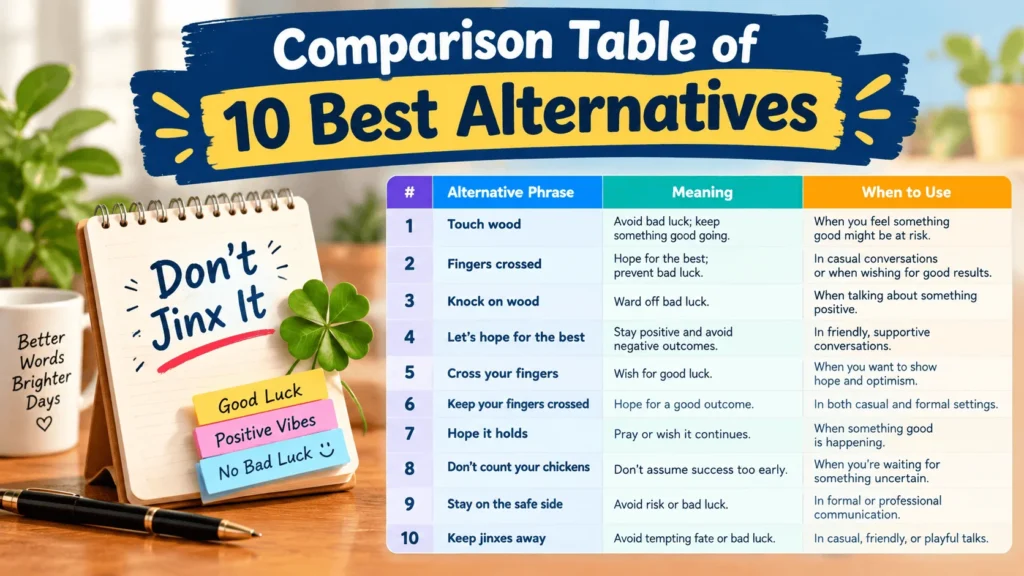
These ten alternatives cover the most useful range, from casual and playful expressions to clear professional wording. The best choice depends on whether you want to express superstition, hope, caution, or simple uncertainty.
| Phrase | Meaning | Best Use | Worst Use | Tone | US vs UK Usage |
| Don’t Tempt Fate | Avoid unnecessary confidence or risk. | Casual caution | Formal reports | Casual, dramatic | Common in both |
| Fingers Crossed | Hope for a positive result. | Waiting for news | Formal analysis | Hopeful, casual | Common in both |
| Knock on Wood | Avoid bad luck after mentioning good fortune. | Casual conversation | Academic writing | Playful, superstitious | Common in US; understood in UK |
| Let’s Wait and See | Avoid judging before the result is known. | Professional communication | Playful banter | Neutral | Common in both |
| Don’t Get Ahead of Yourself | Avoid assuming success too early. | Work and planning | Sensitive emotional situations | Direct, practical | Common in both |
| Let’s Not Celebrate Too Soon | Do not treat expected success as final. | Projects and competitions | Confirmed results | Friendly, cautious | Common in both |
| Let’s Hope for the Best | Express optimism despite uncertainty. | Everyday support | Precise risk analysis | Positive, supportive | Common in both |
| Don’t Speak Too Soon | Avoid premature predictions. | Sports and conversation | Confirmed outcomes | Casual, cautionary | Common in both |
| Let’s Not Assume It Yet | Do not treat an uncertain result as fact. | Meetings and business | Humorous social posts | Neutral, professional | Common in both |
| Let’s Not Get Ahead of Ourselves | Stay realistic before success is confirmed. | Business and team planning | Very informal jokes | Practical, collaborative | Common in both |
Conclusion:
“Don’t jinx it” is a widely understood informal English expression used when someone wants to avoid being overly confident about a positive but uncertain outcome. Its meaning combines caution, optimism, humor, and mild superstition, making it especially common in everyday conversations, workplace chats, sports discussions, social media, and messages between friends. Although the phrase is natural and expressive, it is not appropriate for every situation.
In formal emails, academic writing, legal documents, and professional reports, clearer alternatives such as “let’s wait and see,” “let’s not assume it yet,” or “the outcome remains uncertain” are usually more effective. Understanding these differences helps ESL learners and professionals choose language that matches their audience and purpose. Whether you want to sound friendly, cautious, encouraging, or professional, knowing the alternatives to “don’t jinx it” gives you greater flexibility. Ultimately, effective communication depends on choosing words that communicate the intended meaning while fitting the tone and context.
FAQs:
[faq_accordion]What does “Don’t Jinx It” mean?
“Don’t jinx it” means do not talk about or assume a positive outcome too confidently because something might go wrong. It is usually used playfully rather than literally. For example, if someone says, “We’re definitely going to win,” another person might respond, “Don’t jinx it.” The phrase expresses caution about an uncertain result.
Is “Don’t Jinx It” a professional phrase?
“Don’t jinx it” is generally informal rather than professional. It can be acceptable in relaxed workplace conversations with familiar colleagues, but it is less suitable for formal reports, client emails, academic writing, or official documents. In professional situations, alternatives such as “let’s wait and see” or “the outcome is not certain yet” provide greater clarity.
Is “Don’t Jinx It” rude?
No, “don’t jinx it” is usually not considered rude. Its tone is commonly playful, friendly, or lightly cautionary. However, tone depends on context and delivery. If said sharply, it could sound dismissive. With friends or trusted colleagues, it normally communicates a humorous request not to become too confident about an uncertain situation.
What is another way to say “Don’t Jinx It”?
Common alternatives include “don’t tempt fate,” “fingers crossed,” “knock on wood,” “let’s wait and see,” “don’t speak too soon,” and “let’s not get ahead of ourselves.” The best alternative depends on your intended tone. “Fingers crossed” expresses hope, while “let’s wait and see” sounds more neutral and professional.
What is the opposite of “Don’t Jinx It”?
There is no exact opposite, but expressions such as “count on it,” “we’ve got this,” or “it’s definitely going to happen” communicate greater confidence. While “don’t jinx it” emphasizes uncertainty and caution, these expressions suggest that the speaker believes the desired outcome is highly likely or already secure.
Can “Don’t Jinx It” be used in an email?
Yes, but mainly in informal emails or relaxed internal workplace communication. For example: “The client has approved the proposal so far—don’t jinx it, but I think we’re nearly finished.” In a formal client email, a clearer option would be: “The proposal is progressing well, although final approval is still pending.”
Is “Don’t Jinx It” used in American and British English?
Yes. “Jinx” is understood and used in both American and British English. The core meaning is essentially the same. American speakers commonly use “don’t jinx it” in casual conversations and sports contexts, while British speakers also understand it naturally. “Touch wood” is another familiar British expression associated with avoiding bad luck.
Why do people say “Don’t Jinx It”?
People say “don’t jinx it” because they want to avoid premature confidence about something that is still uncertain. The expression is often humorous rather than a serious statement about supernatural luck. It provides a short way to acknowledge that something is going well while reminding others that the final result has not yet been confirmed.
What is the difference between “Don’t Jinx It” and “Fingers Crossed”?
“Don’t jinx it” focuses on avoiding actions or words that might supposedly bring bad luck, while “fingers crossed” expresses hope for a positive outcome. For example, “The interview went well—fingers crossed” shows optimism. “The interview went well, so don’t jinx it” emphasizes caution about assuming success before receiving the result.
Is “Don’t Jinx It” suitable for ESL learners?
Yes. ESL learners can use “don’t jinx it” naturally once they understand its informal meaning and context. It is especially useful in conversations, chats, and social situations. However, learners should avoid relying on it in formal writing. For professional communication, straightforward phrases such as “let’s wait and see” are often clearer and more universally appropriate.
[/faq_accordion]