
Imagine you are in a meeting and have an idea that could save your team time, or you are talking with a friend about a plan that could work well for both of you. You might say, “I have a proposition.” The sentence is short, direct, and designed to signal that you want to present an idea, offer, arrangement, or possible course of action.
In modern English, however, the exact wording you choose matters. “I have a Proposition” can sound professional in one situation but slightly dramatic, old-fashioned, or mysterious in another. Alternatives such as “I have a proposal,” “I’d like to suggest something,” or “I have an idea” can make your intention clearer and better suited to your audience.
What Does “I Have a Proposition” Mean?
“I Have a Proposition” means that the speaker has a specific idea, offer, plan, or arrangement that they want another person to consider. The phrase is commonly used before presenting a business proposal, personal suggestion, negotiation, collaboration, or possible agreement. Its meaning depends on context, but it generally signals that the speaker intends to make a concrete suggestion.
Origin & History of “I Have a Proposition”
The key word “proposition” comes from Latin propositio, meaning something put forward or presented for consideration. It entered English through Old French and developed into a word associated with a statement, idea, proposal, or suggested course of action.
Historically, proposition had several meanings. In logic and philosophy, it referred to a statement that could be examined or judged as true or false. In mathematics, it came to describe a statement or problem requiring proof. In everyday English, however, it increasingly developed the practical meaning of an offer, suggestion, or proposed arrangement.
The expression “I have a proposition” therefore follows a long linguistic pattern: a speaker announces that they have something to put before another person for consideration.
Over time, the phrase became particularly associated with negotiation, business arrangements, deals, and persuasive conversations. Today, it remains understandable and grammatically natural, although alternatives such as “I have a proposal” and “I’d like to suggest something” are often preferred in modern professional communication.
Context also matters because “proposition” can sometimes carry a more dramatic or suggestive tone. That is why experienced speakers often choose a more specific alternative when clarity is important.
Synonyms & Alternatives by Tone
Professional & Neutral Alternatives
- I have a proposal.
- I have a suggestion.
- I’d like to propose something.
- I have an idea.
- I’d like to suggest something.
- I’d like to put forward an idea.
- I have an offer to discuss.
Polite & Supportive Alternatives
- I’d like to share an idea.
- May I suggest something?
- I wanted to discuss an option with you.
- I’d like to explore an idea with you.
- Could we consider another approach?
Encouraging & Reassuring Alternatives
- I have an idea that might help.
- I think we could try something different.
- I’d like to offer a possible solution.
- There may be another option we can explore.
- I think I have a workable suggestion.
Casual, Playful & Idiomatic Alternatives
- I’ve got an idea.
- Hear me out.
- I have a thought.
- How about this?
- What if we tried this?
- I’ve got something to suggest.
When Should You Use “I Have a Proposition”?
Professional Settings
The phrase can work when you are about to introduce a specific offer, arrangement, partnership, or negotiation.
For example:
“I have a proposition that could benefit both departments.”
This sounds more deliberate than simply saying, “I have an idea.”
In a business setting, however, “I have a proposal” is usually clearer when discussing a formal document, project, contract, or business plan.
Casual Conversations
In informal conversation, the phrase can be used when you want to introduce an interesting plan or suggestion.
“I have a proposition: you cook tonight, and I’ll do the dishes.”
The wording may sound playful because the situation is informal.
Writing, Presentations, and Digital Communication
In writing, the phrase is useful when the writer wants to introduce a specific offer or argument. In presentations, it can create a clear transition into a proposed solution.
For email and workplace messaging, though, a more precise phrase is often better:
“I’d like to propose a revised timeline.”
This tells the reader exactly what is coming.
When It Is Especially Effective
“I Have a Proposition” works best when the listener is expected to consider an offer or arrangement. It is especially useful when the proposal has two sides, such as a business deal, collaboration, exchange, compromise, or negotiated plan.
When Should You Avoid “I Have a Proposition”?
Overly Formal Situations
Although the phrase is not extremely formal, it can sound more serious or theatrical than necessary. In everyday workplace communication, “I have a suggestion” may feel more natural.
Legal, Academic, or Sensitive Contexts
In legal communication, precision is more important than conversational style. Instead of saying:
“I have a proposition.”
It may be better to state exactly what is being proposed.
Academic writing also generally favors specific language, such as:
“This paper proposes…”
rather than conversational announcements.
Situations Where Nuance May Be Lost
The word proposition does not always tell the listener what kind of idea is being offered. It could mean a business arrangement, personal request, suggestion, or deal.
If your audience needs immediate clarity, choose a more specific expression.
Real-Life Examples of “I Have a Proposition” by Context
“Hi Daniel, I have a proposition that could make the upcoming project easier for both teams. If you’re available this week, I’d like to walk you through it.”
Meeting
“I have a proposition for the team. Instead of extending the deadline, we could move two people temporarily to the testing phase.”
Presentation
“I have a proposition for improving customer response times: let’s introduce a dedicated support channel during peak hours.”
Conversation
“I have a proposition. You choose the movie tonight, and I’ll choose the restaurant.”
Social Media
“I have a proposition for everyone complaining about Monday: let’s stop checking our emails before breakfast.”
“I Have a Proposition” vs Similar Expressions: Key Differences
| Phrase | Meaning Difference | Tone Difference | Best Use Scenario |
| I have a proposal | Introduces a structured or formal plan | Professional and formal | Business, projects, partnerships |
| I have a suggestion | Introduces an idea without strongly presenting it as an offer | Polite and collaborative | Meetings, teamwork, everyday discussions |
| I have an idea | Introduces a thought or possible solution | Casual and approachable | Brainstorming and informal discussions |
| I’d like to propose something | Clearly signals that the speaker wants to put forward a specific plan | Professional and direct | Meetings, negotiations, presentations |
| I’d like to suggest something | Presents an idea more softly | Polite and cooperative | Workplace and sensitive conversations |
| I have an offer | Usually indicates something concrete that another person can accept or reject | Direct and transactional | Sales, negotiations, partnerships |
The central difference is how strongly the speaker presents the idea and what kind of response is expected. “I have a proposition” emphasizes an offer or arrangement, while “I have an idea” is much broader and less formal.
Common Mistakes & Misuse of “I Have a Proposition”
Overuse
Using “I have a proposition” for every small idea can make ordinary conversations sound unnecessarily serious.
Instead of:
“I have a proposition. Should we order pizza?”
you could simply say:
“How about pizza?”
Incorrect Context
A formal proposal and a casual suggestion are not always interchangeable.
For example, a major business partnership may deserve “I have a proposal”, while a minor workplace recommendation may sound better as “I have a suggestion.”
Contradictory Usage
Avoid introducing something as a serious proposition and then presenting an unrelated or trivial point. The wording creates an expectation that something concrete or meaningful will follow.
Cultural Misunderstandings
Some listeners may associate “proposition” with a personal or romantic offer depending on the context. If your intention is purely professional, using “proposal” or “suggestion” can remove unnecessary ambiguity.
Psychological Reasons People Prefer “I Have a Proposition”
Cognitive Load Reduction
A short opening phrase helps listeners understand what type of information is coming. “I have a proposition” prepares the audience to evaluate an offer or plan.
Trust and Authority Signals
The phrase can sound deliberate and confident. It suggests that the speaker has considered an idea before presenting it.
That effect can be useful in negotiation, but too much certainty can sometimes make a speaker appear less collaborative.
Attention Economy
Modern communication is fast. People often scan emails, messages, and workplace updates rather than reading every sentence carefully. A phrase that signals an upcoming proposal can help focus attention.
Modern Communication Habits
Digital communication has encouraged shorter openings such as:
“Quick idea…”
“I have a suggestion…”
“Could we try this?”
These alternatives often feel more natural because they match the speed and informality of modern workplace communication.
“I Have a Proposition” in Digital & Modern Communication
Emails
In email, clarity is more important than suspense. If you use the phrase, explain the proposition immediately.
Better:
“I have a proposition regarding the project schedule: could we move the launch to Thursday?”
Slack / WhatsApp
Shorter language usually feels more natural:
“I’ve got a proposition—what if we finish the draft tonight and review it tomorrow?”
For casual messaging, “I’ve got an idea” may sound even more natural.
Social Media
The phrase can be useful for humor or engagement:
“I have a proposition: everyone gets one extra hour of sleep on Mondays.”
Here, its slightly dramatic quality becomes part of the humor.
AI-Generated Summaries
AI-generated summaries should normally replace vague phrasing with precise language. If a source says, “I have a proposition,” a summary might explain the actual proposition rather than merely repeating the phrase.
For example:
Original: “I have a proposition. Let’s combine the two teams.”
Clear summary: “The speaker proposes combining the two teams.”
Linguistic & Communication Insight
Emotional Weight & Subtext
Native speakers do not process words only by their dictionary definitions. They also respond to context, expectations, and implied intention.
“I have a proposition” creates an expectation that something specific is about to be offered. Because “proposition” can sound more serious than “idea,” listeners may become more attentive.
In certain contexts, it can also feel slightly mysterious:
“I have a proposition for you.”
This can sound like the speaker is about to make a significant offer.
Direct vs Indirect Phrasing
The phrase is relatively direct because it announces an intention to present something.
Compare:
“I have a proposition.”
with:
“I was wondering if we might consider another option.”
The first is more confident and direct. The second reduces pressure and gives the listener more conversational space.
Neither is universally better. Direct language works well when clarity and efficiency matter; indirect language can work better when the subject is sensitive, or disagreement is likely.
Professional Communication Perspective
In professional communication, the phrase can signal confidence, but experienced communicators usually choose words according to the relationship and purpose.
For a formal business plan:
“I have a proposal.”
For a collaborative workplace discussion:
“I have a suggestion.”
For brainstorming:
“I have an idea.”
The best phrase is therefore the one that accurately reflects the seriousness and nature of the message.
Pragmatic Reasons for Alternatives
Professionals often choose alternatives to avoid creating unnecessary defensiveness.
For example, “I’d like to suggest something” sounds collaborative. It gives the other person room to respond without making the speaker appear to have already decided the outcome.
Similarly, “Could we consider another option?” frames the idea as a shared exploration rather than a demand.
Social Signaling
Word choice communicates more than information. It can signal:
- Confidence
- Cooperation
- Authority
- Openness
- Formality
- Urgency
- Respect
“I have a proposition” tends to signal confidence and intention, while “I have an idea” tends to signal openness and informality.
Tone & Context Guidance
Use “I have a proposition” when you genuinely have an offer, arrangement, or concrete plan.
Choose something softer when:
- The topic is sensitive.
- You want collaboration rather than negotiation.
- The audience may interpret “proposition” too seriously.
- The idea is still undeveloped.
- You need to avoid possible ambiguity.
Meaning, Usage & Examples for Each Alternative
I Have a Proposal
Meaning: “I have a proposal” means the speaker has a specific plan or formal suggestion for another person or group to consider. It often implies that the idea has been developed enough to discuss seriously.
Why This Phrase Works: It is clearer and more common than “I have a proposition” in many professional settings. It immediately suggests a structured plan rather than an unspecified idea.
Real-World Usage Insight: Professionals frequently use “proposal” when discussing projects, partnerships, budgets, timelines, or business arrangements.
Best Use: Business meetings, project discussions, formal emails, partnerships, presentations.
Avoid When: The idea is extremely casual or only a passing thought.
Tone: Professional, clear, serious, and neutral.
US vs UK Usage: Common and natural in both American and British English.
Example (Email / Message / Meeting): “I have a proposal for reducing the project’s turnaround time without adding another person to the team.”
I Have a Suggestion
Meaning: “I have a suggestion” introduces an idea that the speaker believes may be useful but does not necessarily expect others to accept.
Why This Phrase Works: It sounds cooperative and gives other people room to disagree.
Real-World Usage Insight: This is particularly useful in workplaces because it avoids making a recommendation sound like an order.
Best Use: Team meetings, feedback, problem-solving, classroom discussions.
Avoid When: You are presenting a formal contract or fully developed business plan.
Tone: Polite, collaborative, and moderate.
US vs UK Usage: Very natural in both varieties of English.
Example (Email / Message / Meeting): “I have a suggestion: what if we send the survey out on Friday instead of Monday?”
I’d Like to Suggest Something
Meaning: This phrase politely introduces an idea or possible action.
Why This Phrase Works: It balances confidence with respect and does not pressure the listener to agree.
Real-World Usage Insight: It is particularly effective when giving feedback or recommending a change.
Best Use: Workplace communication, sensitive conversations, classroom settings.
Avoid When: You need to communicate a firm decision rather than a suggestion.
Tone: Polite, respectful, and collaborative.
US vs UK Usage: Common and natural in both varieties.
Example (Email / Message / Meeting): “I’d like to suggest something before we publish the article: let’s have one more person review the statistics.”
I’d Like to Put Forward an Idea
Meaning: This means the speaker wants to formally introduce an idea for consideration.
Why This Phrase Works: It makes the speaker’s intention clear and sounds suitable for structured discussions.
Real-World Usage Insight: The expression is useful when several people are contributing ideas, and the speaker wants to mark a specific contribution.
Best Use: Meetings, committees, presentations, professional discussions.
Avoid When: Talking casually with close friends.
Tone: Professional and deliberate.
US vs UK Usage: Understood in both, with a slightly formal feel.
Example (Email / Message / Meeting): “I’d like to put forward an idea for the next campaign: let’s focus on customer stories rather than product features.”
I’d Like to Share an Idea
Meaning: The speaker wants to introduce an idea without strongly suggesting that others must adopt it.
Why This Phrase Works: “Share” creates a friendly and collaborative feeling.
Real-World Usage Insight: It is useful when encouraging participation rather than controlling the discussion.
Best Use: Teamwork, brainstorming, workshops, classrooms, online communities.
Avoid When: You need to present a formal demand or binding arrangement.
Tone: Warm, open, and cooperative.
US vs UK Usage: Common in both American and British English.
Example (Email / Message / Meeting): “I’d like to share an idea that might make onboarding easier for new writers.”
May I Suggest Something?
Meaning: This is a polite way to ask for permission to introduce an idea.
Why This Phrase Works: It acknowledges the other person’s role in the conversation and reduces the force of the suggestion.
Real-World Usage Insight: It can be especially useful when speaking to someone senior or when correcting a sensitive situation.
Best Use: Professional discussions, customer service, formal conversations.
Avoid When: The environment is extremely casual and familiar.
Tone: Polite, respectful, and somewhat formal.
US vs UK Usage: Natural in both varieties, although it can sound more formal in casual American conversation.
Example (Email / Message / Meeting): “May I suggest something? We could move the review meeting to Thursday so everyone has more time to prepare.”
I Wanted to Discuss an Option With You
Meaning: This phrase introduces a possible choice or course of action that the speaker wants to explore with another person.
Why This Phrase Works: It sounds less forceful than saying that the speaker already has a proposition.
Real-World Usage Insight: It is excellent when the final decision should be shared rather than imposed.
Best Use: Management, workplace conversations, planning, sensitive discussions.
Avoid When: A decision has already been finalized.
Tone: Professional, diplomatic, and collaborative.
US vs UK Usage: Natural in both American and British English.
Example (Email / Message / Meeting): “I wanted to discuss an option with you before we lock in the new publishing schedule.”
I’d Like to Explore an Idea With You
Meaning: The phrase means that the speaker wants to examine an idea together rather than simply present it as a finished proposal.
Why This Phrase Works: “Explore” suggests openness and collaboration.
Real-World Usage Insight: It is especially useful when the idea is promising but still needs discussion.
Best Use: Strategy meetings, creative projects, partnerships, brainstorming.
Avoid When: You need a quick yes-or-no decision.
Tone: Collaborative, thoughtful, and professional.
US vs UK Usage: Common in both varieties of English.
Example (Email / Message / Meeting): “I’d like to explore an idea with you about combining the two content calendars.”
I Have an Idea That Might Help
Meaning: This phrase introduces a possible solution while avoiding the claim that it is definitely the right answer.
Why This Phrase Works: The words “might help” make the speaker sound open-minded rather than overly certain.
Real-World Usage Insight: It is useful when offering help without appearing to take control.
Best Use: Teamwork, customer support, problem-solving, everyday conversations.
Avoid When: You need to communicate a confirmed policy or decision.
Tone: Helpful, reassuring, and friendly.
US vs UK Usage: Natural in both American and British English.
Example (Email / Message / Meeting): “I have an idea that might help: we could divide the research into three smaller sections and review them separately.”
I Think We Could Try Something Different
Meaning: This expression suggests changing the current method and testing another possibility.
Why This Phrase Works: It is gentle and avoids presenting the existing approach as a failure.
Real-World Usage Insight: The phrase works well when people are already invested in the current plan and may react defensively to criticism.
Best Use: Workplace feedback, creative discussions, personal conversations.
Avoid When: You need a formal proposal with defined terms.
Tone: Gentle, encouraging, and conversational.
US vs UK Usage: Common in both varieties.
Example (Email / Message / Meeting): “I think we could try something different with the newsletter and use shorter sections.”
I’d Like to Offer a Possible Solution
Meaning: The speaker is presenting an option that may solve a particular problem.
Why This Phrase Works: It directly connects the idea to a practical outcome.
Real-World Usage Insight: This wording is particularly useful when a discussion is focused on solving a known problem.
Best Use: Customer service, workplace issues, project management, technical discussions.
Avoid When: You have not yet identified the actual problem.
Tone: Professional, constructive, and solution-focused.
US vs UK Usage: Natural in both American and British English.
Example (Email / Message / Meeting): “I’d like to offer a possible solution to the scheduling issue: we could move the weekly review to Wednesday afternoon.”
There May Be Another Option We Can Explore
Meaning: This phrase suggests that another possibility exists without claiming that it is necessarily better.
Why This Phrase Works: It is highly diplomatic and leaves room for discussion.
Real-World Usage Insight: Experienced communicators often use this kind of wording when they want to challenge an existing plan without creating confrontation.
Best Use: Negotiations, management, teamwork, sensitive decisions.
Avoid When: You need to communicate a clear recommendation immediately.
Tone: Diplomatic, cautious, and collaborative.
US vs UK Usage: Natural in both varieties of English.
Example (Email / Message / Meeting): “There may be another option we can explore before we reduce the team size. I’d be happy to discuss it tomorrow.”
Comparison Table of 10 Best Alternatives
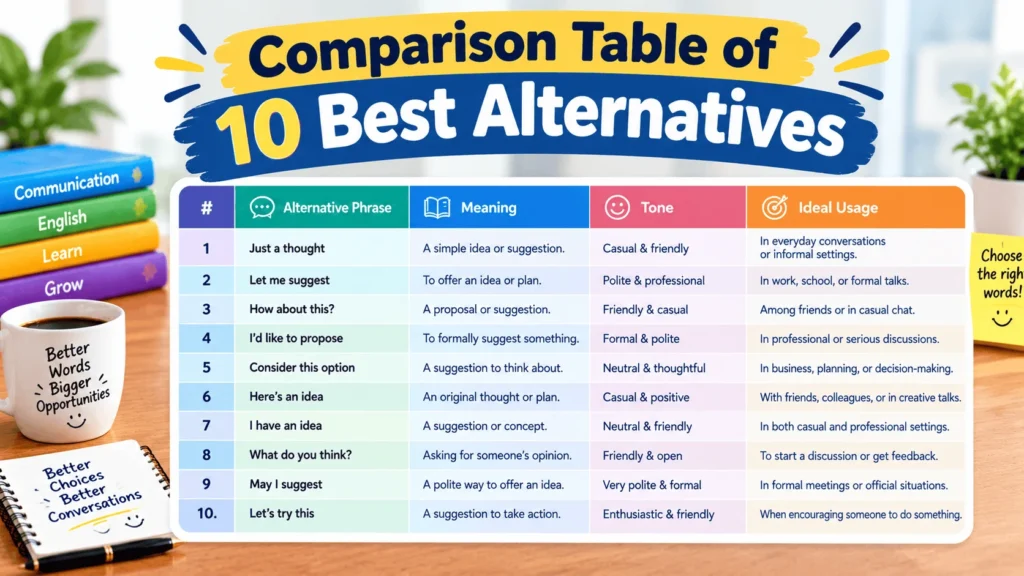
These ten alternatives cover the most useful situations, from formal business communication to casual brainstorming. The best choice depends on how formal the situation is, how specific the idea is, and how strongly you want to present it.
| Phrase | Meaning | Best Use | Worst Use | Tone | US vs UK Usage |
| I Have a Proposal | A specific or structured plan | Business and projects | Very casual chats | Professional | Common in both |
| I Have a Suggestion | An idea offered for consideration | Team discussions | Binding agreements | Polite | Common in both |
| I’d Like to Propose Something | A deliberate plan or recommendation | Meetings and negotiations | Minor comments | Direct | Common in both |
| I Have an Idea | A possible thought or solution | Brainstorming | Formal contracts | Friendly | Extremely common in both |
| I’d Like to Suggest Something | A polite recommendation | Workplace communication | Firm decisions | Collaborative | Common in both |
| I Have an Offer to Discuss | A concrete offer | Negotiations and sales | Casual opinions | Transactional | Common in both |
| I’d Like to Share an Idea | An idea presented openly | Teamwork and brainstorming | Legal communication | Warm | Common in both |
| May I Suggest Something? | A respectful request to introduce an idea | Formal or sensitive discussions | Very casual chats | Respectful | Common in both |
| Could We Consider Another Approach? | A request to examine another method | Feedback and problem-solving | Urgent decisions | Diplomatic | Common in both |
| I’ve Got an Idea | An informal suggestion | Casual conversations | Highly formal writing | Casual | Common in both |
The most important takeaway is simple: “I Have a Proposition” is grammatically correct and understandable, but it is not always the most natural choice. Use “proposal” for a formal plan, “suggestion” for a collaborative idea, “idea” for casual brainstorming, and “offer” when something concrete is being presented for acceptance.
Choosing the right alternative makes your communication clearer, more natural, and more appropriate for the person and situation you are addressing.
Conclusion:
“I Have a Proposition” is a clear and grammatically correct expression used to introduce an idea, offer, plan, or possible arrangement. Its meaning is straightforward, but its tone can change significantly depending on the situation, audience, and words that follow it. In professional communication, “I have a proposal” may sound more natural when discussing a structured business plan, while “I have a suggestion” is often better for collaborative discussions.
For casual conversations, “I have an idea” or “I’ve got an idea” usually feels more relaxed and conversational. Understanding these differences helps speakers and writers choose language that is precise, natural, and appropriate. Whether you are writing an email, participating in a meeting, speaking with a friend, or learning English as a second language, selecting the right alternative can improve clarity and prevent unintended meanings. Ultimately, effective communication is not only about what you say but also how your choice of words makes the listener feel and respond.
FAQs:
[faq_accordion]What does “I Have a Proposition” mean?
“I Have a Proposition” means that someone has an idea, offer, plan, or arrangement they want another person to consider. It often introduces something specific that may require discussion, agreement, or negotiation. The phrase can be used in business, personal conversations, meetings, and informal situations, although its tone may vary according to context.
Is “I Have a Proposition” professional?
Yes, “I have a Proposition” can be professional, particularly when discussing a specific offer, business arrangement, or negotiation. However, it can sound slightly formal or dramatic in some workplace situations. For a formal business plan, “I have a proposal” is usually more natural, while “I have a suggestion” works better for collaborative workplace discussions.
Is “I have a Proposition” polite?
Yes, the phrase is generally polite and neutral. It does not automatically sound rude or demanding. However, “proposition” can make the speaker sound serious or deliberate. If you want a softer approach, expressions such as “I’d like to suggest something” or “I have an idea that might help” can create a more cooperative impression.
What is a better alternative to “I have a Proposition”?
The best alternative depends on the context. “I have a proposal” is suitable for formal plans, “I have a suggestion” works for recommendations, and “I have an idea” is ideal for casual discussions. Other useful choices include “I’d like to propose something,” “I’d like to share an idea,” and “Could we consider another approach?”
Can “I Have a Proposition” sound romantic?
It can, depending on the context. Although the phrase commonly means “I have an offer or proposal to discuss,” the word “proposition” can sometimes carry a personal or suggestive meaning. This is why professionals may choose “I have a proposal” or “I have a suggestion” when they want to make their intended meaning completely clear.
What is the difference between “I have a Proposition” and “I have a Proposal”?
Both expressions introduce something for consideration, but “proposal” is generally more common for formal plans, business arrangements, and structured recommendations. “Proposition” can sound broader, more deliberate, or slightly dramatic. In professional English, “I have a proposal” is often the safer choice when presenting a defined project, partnership, or business plan.
What is the difference between “I have a Proposition” and “I have a Suggestion”?
“I have a Proposition” usually suggests a more concrete offer or arrangement, while “I have a suggestion” presents an idea more gently. A proposition may invite negotiation or agreement, whereas a suggestion gives the listener more freedom to accept, reject, or modify the idea. Therefore, “suggestion” often sounds more collaborative and less formal.
Is “I have a Proposition” common in American and British English?
Yes, the expression is understood in both American and British English. There is no major difference in its basic meaning. However, everyday speakers in both varieties often choose alternatives such as “I have an idea,” “I have a suggestion,” or “I have a proposal.” The main difference is stylistic rather than grammatical or regional.
How can I use “I have a Proposition” in an email?
Use the phrase when you are introducing a specific idea, offer, or arrangement. For example: “I have a proposition regarding the project timeline. Could we move the launch date to Thursday?” In formal business emails, “I have a proposal” may sound more polished. Always explain the proposition immediately so the reader understands what you are suggesting.
What is the most natural casual alternative to “I have a Proposition”?
For casual English, “I have an idea” or “I’ve got an idea” is usually the most natural alternative. These expressions are common in conversations, messaging, brainstorming, and everyday situations. If you want to sound playful, you can also say “Hear me out” or “What if we tried this?”, depending on the context.
[/faq_accordion]