
Imagine a coworker tells you that a client meeting was moved to an earlier time without warning, and you discover that someone else knew about the change but did not tell you. You might naturally say, “You set me up!” The phrase immediately communicates a feeling that someone deliberately put you in a difficult, embarrassing, or unfair situation.
But “You set me up” can mean different things depending on context. It may describe deliberate deception, an unfair situation, a practical arrangement, or even a joke between friends. For ESL learners, students, professionals, and content writers, understanding these differences matters because the phrase can sound playful in one situation and strongly accusatory in another.
The alternatives below help you choose wording that better matches your intention, whether you want to sound professional, polite, supportive, humorous, or direct.
What Does “You Set Me Up” Mean?
“You set me up” means that someone arranged a situation in a way that caused you to face difficulty, embarrassment, blame, or deception, often intentionally. The phrase is commonly used when a person believes another person deliberately created an unfavorable situation, tricked them, or made them appear responsible for something. Its exact meaning depends strongly on context and tone.
Origin & History of “You Set Me Up”
The expression comes from the broader phrasal verb “set up,” which has been used in English for centuries with several meanings, including arranging, establishing, preparing, or positioning something. Over time, “set someone up” developed additional meanings involving placing a person into a particular situation.
The negative sense became especially associated with situations where someone is deliberately placed in trouble or made vulnerable to blame. For example, saying that someone was “set up” can imply that evidence, circumstances, or events were arranged to make that person look guilty or responsible.
The phrase also developed more informal meanings. Friends may say “You set me up” after a practical joke, an unexpected introduction, or a situation designed to produce a funny reaction. In modern English, context determines whether the phrase sounds like a serious accusation or lighthearted teasing.
Synonyms & Alternatives by Tone
Professional & Neutral Alternatives
- You put me in a difficult position.
- You placed me in an awkward situation.
- You put me at a disadvantage.
- You arranged this without telling me.
- You made me responsible for something unexpectedly.
- You put me in a challenging situation.
Polite & Supportive Alternatives
- I felt caught off guard.
- I wasn’t prepared for that situation.
- I wish I had known beforehand.
- That put me in an uncomfortable position.
- I wasn’t aware that this was going to happen.
- I could have used more information.
Encouraging & Reassuring Alternatives
- I understand what happened.
- Let’s work through this.
- We can sort this out.
- Don’t worry; we’ll handle it.
- Let’s clear up the misunderstanding.
- We can find a better way forward.
Casual, Playful & Idiomatic Alternatives
- You got me good.
- You caught me off guard.
- You pulled a fast one on me.
- You threw me under the bus.
- You blindsided me.
- You caught me in a trap.
- You played me.
- You tricked me.
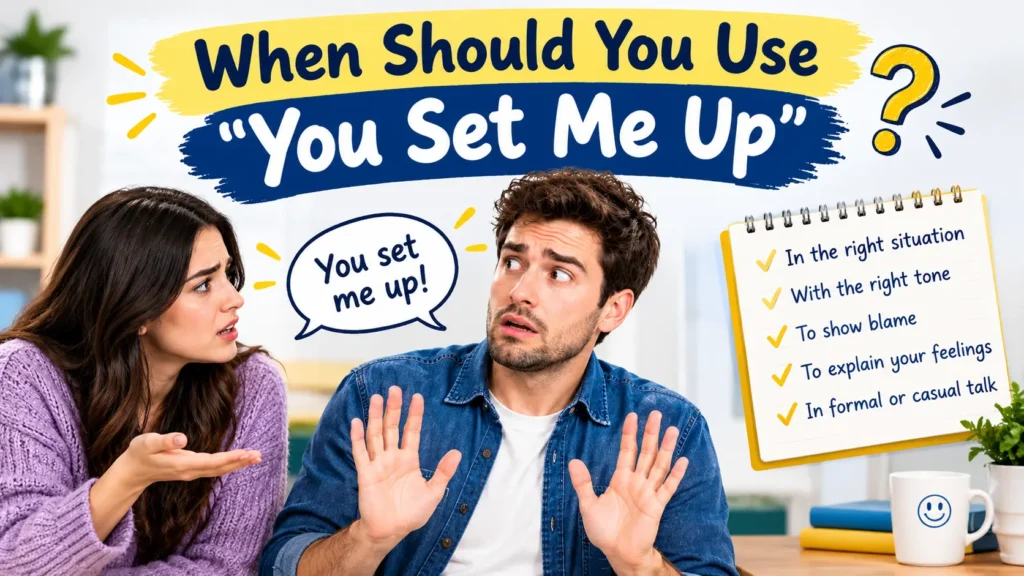
When Should You Use “You Set Me Up”?
Professional Settings
Use “You set me up” carefully at work. It can sound like a direct accusation, especially when discussing responsibility, mistakes, deadlines, or workplace conflict. In a casual conversation with a trusted coworker, it may be acceptable, but a neutral alternative is usually safer.
For example, instead of saying:
“You set me up to fail.”
a professional speaker might say:
“I didn’t have the information I needed to handle that situation effectively.”
The second version communicates the problem without immediately assigning hostile intent.
Casual Conversations
The phrase is very natural among friends, relatives, teammates, and people who already understand each other’s communication style.
For example:
“You knew they were going to ask me that. You totally set me up!”
Here, the speaker may be annoyed but could also be joking.
Writing, Presentations, and Digital Communication
In writing, tone becomes harder to judge because readers cannot hear your voice or see your facial expression. In emails, Slack messages, comments, and professional posts, “You set me up” may therefore sound harsher than intended.
When It Is Especially Effective
The phrase works well when you specifically want to communicate that someone’s actions placed you in an unfavorable situation. It is particularly effective in informal speech where emotional directness is acceptable.
When Should You Avoid “You Set Me Up”?
Avoid the phrase when the situation requires careful neutrality, especially when assigning responsibility.
Overly Formal Situations
In formal reports, executive communication, or official correspondence, “You set me up” may sound emotional or confrontational.
Legal, Academic, or Sensitive Contexts
Legal and academic writing generally requires precise descriptions of actions rather than assumptions about someone’s intentions. Instead of accusing someone of setting you up, describe exactly what happened.
Situations Where Nuance May Be Lost
Text messages and emails lack vocal tone. A phrase intended as playful teasing may be interpreted as a serious accusation.
If your relationship with the reader is uncertain, use a clearer and less emotionally loaded alternative.
Is “You Set Me Up” Professional, Polite, or Casual?
“You set me up” is generally informal and conversational. It is not inherently rude, but it can become confrontational when the speaker genuinely believes another person intentionally caused harm or embarrassment.
Its emotional subtext often includes surprise, frustration, suspicion, disappointment, or playful accusation. The phrase can therefore shift significantly depending on facial expression, relationship, and surrounding words.
In professional communication, alternatives such as “You put me in a difficult position” or “I wasn’t aware of that beforehand” usually provide greater control over tone.
Pros and Cons of Using “You Set Me Up”
Advantages
- Clarity: It quickly communicates that another person’s actions affected your situation.
- Efficiency: A short phrase can express a complicated feeling without a long explanation.
- Accessibility: It is common conversational English and is easy for many listeners to understand.
Potential Drawbacks
- Oversimplification: It may imply intentional wrongdoing when the situation was actually accidental.
- Tone mismatch: It can sound aggressive in formal or sensitive situations.
- Repetition: Frequent use can make communication sound reactive rather than thoughtful.
Real-Life Examples of “You Set Me Up” by Context
“I thought the presentation was scheduled for Friday. When I found out it had been moved to Wednesday, I felt like you set me up because I hadn’t received the updated schedule.”
For a professional email, however, a less accusatory version would usually be better.
Meeting
“Wait, you knew the director was going to ask about the budget? You set me up!”
This can sound humorous if the speaker and listener have a friendly relationship.
Presentation
“You asked me to explain the technical section without giving me the latest figures. I felt like you set me up.”
This communicates frustration, although a professional presentation setting may call for softer wording.
Conversation
“You invited both of us and didn’t tell me she would be there. You set me up!”
Depending on delivery, this can communicate genuine frustration or playful teasing.
Social Media
“My friends told me this was just a casual dinner. Then I walked in, and everyone shouted surprise. You set me up!”
Here, the phrase is clearly playful rather than accusatory.
“You Set Me Up” vs Similar Expressions
| Phrase | Meaning Difference | Tone Difference | Best Use Scenario |
| You put me in a difficult position | Focuses on the difficult circumstances rather than deliberate deception. | Professional, neutral | Workplace discussions |
| You caught me off guard | Means you surprised or surprised someone without preparation. | Neutral, mildly emotional | Unexpected questions or events |
| You blindsided me | Suggests something unexpected and potentially upsetting happened. | Direct, emotional | Serious conversations |
| You threw me under the bus | Means someone shifted blame or sacrificed your reputation to protect themselves. | Informal, critical | Workplace or social conflict |
| You played me | Suggests someone manipulated, deceived, or took advantage of you. | Casual, accusatory | Informal relationships |
| You pulled a fast one on me | Means someone tricked or deceived you, often in a relatively lighthearted way. | Casual, playful | Jokes or minor deception |
Key Differences
“You set me up” is broader than many of these expressions. It can suggest that someone deliberately arranged circumstances against you, whereas “you caught me off guard” focuses primarily on surprise.
“You threw me under the bus” specifically involves blame or self-protection. “You played me” focuses more strongly on manipulation. “You blindsided me” emphasizes unexpected impact rather than necessarily deliberate planning.
Psychological Reasons People Prefer “You Set Me Up”
Cognitive Load Reduction
Short expressions allow speakers to communicate complex situations quickly. Instead of explaining every detail, “You set me up” summarizes the speaker’s interpretation of what happened.
Trust and Authority Signals
Direct language can signal confidence and certainty. However, excessive certainty can damage trust if the speaker has not established that the other person acted intentionally.
Attention Economy
Modern communication often rewards short, immediately understandable expressions. A compact phrase can communicate emotion faster than a detailed explanation.
Modern Communication Habits
Messaging platforms encourage brief, expressive language. Phrases such as “You set me up,” “You got me,” and “You blindsided me” work efficiently in conversations where participants already share background information.
US vs UK Usage of “You Set Me Up”
“You set me up” is understood in both American and British English. The basic meaning remains similar, particularly when it refers to deliberately placing someone in a difficult or compromising situation.
American English frequently uses the phrase in informal workplace and social conversations. British speakers also use it naturally, although regional preferences may affect which alternatives sound most familiar.
The biggest difference is usually context and tone rather than meaning. In both varieties, the phrase can sound playful among friends but accusatory in a professional dispute.
“You Set Me Up” in Digital & Modern Communication
Emails
Because email lacks vocal cues, the phrase can appear stronger than intended. If you need to preserve a professional relationship, explain the situation instead of assuming intent.
Slack / WhatsApp
In instant messaging, the phrase is more natural because conversations are often informal and conversational.
“You set me up 😂 I thought that meeting was next week!”
The emoji and surrounding context make the playful meaning clear.
Social Media
The expression frequently works as a humorous reaction to pranks, surprises, awkward photographs, or unexpected situations.
AI-Generated Summaries
AI-generated writing should interpret the phrase according to context rather than automatically labeling it as anger. “You set me up” may indicate accusation, humor, surprise, or frustration depending on the surrounding conversation.
Linguistic & Communication Insight
Emotional Weight & Subtext
Native speakers often understand more than the literal words. “You set me up” can imply, “I believe you knew what would happen, and you allowed or arranged it anyway.”
That implied intention is important. The phrase is therefore stronger than simply saying “I wasn’t prepared.”
Direct vs Indirect Phrasing
The phrase is direct because it identifies another person as responsible for the situation. Softer alternatives shift attention from blame toward circumstances.
Compare:
“You set me up.”
with:
“I wasn’t prepared for that.”
The first assigns responsibility. The second describes the speaker’s experience without explicitly judging the other person’s intention.
Professional Communication Perspective
At work, experienced communicators often separate observable facts from assumptions about motives. Saying what happened first can reduce defensiveness and create room for clarification.
Instead of:
“You set me up to fail.”
consider:
“I didn’t receive the updated information before the meeting, so I wasn’t prepared to answer those questions.”
The second version is more precise and easier to resolve constructively.
Pragmatic Reasons for Alternatives
Professionals may choose alternative expressions to preserve cooperation, avoid unnecessary conflict, and distinguish accidental problems from intentional actions.
Language such as “I was caught off guard” communicates the impact without automatically accusing someone of bad intentions.
Social Signaling
Word choice influences how listeners judge confidence, trustworthiness, fairness, and emotional control. Direct language can create engagement, but overly accusatory language can cause people to become defensive.
Tone & Context Guidance
Use “You set me up” when the relationship is informal and the intended meaning is clear. Choose a softer alternative when discussing workplace problems, sensitive issues, formal writing, or situations where intent has not been established.
Meaning, Usage & Examples for Each Alternative

You Put Me in a Difficult Position
Meaning: This means someone’s actions created circumstances in which you had limited, uncomfortable, or challenging choices. It does not necessarily accuse them of deliberately causing the problem.
Why This Phrase Works: It focuses on the situation and its effect rather than directly accusing the other person of manipulation.
Real-World Usage Insight: This is one of the strongest professional alternatives because it communicates concern without unnecessarily escalating conflict.
Best Use: Workplace conversations, meetings, emails, and sensitive discussions.
Avoid When: You specifically need to emphasize deliberate deception.
Tone: Professional, neutral, controlled.
US vs UK Usage: Common and natural in both varieties of English.
Example (Meeting): “I understand the client needed an answer, but being asked about the revised numbers without the updated report put me in a difficult position.”
You Caught Me Off Guard
Meaning: This means someone surprised you or caused you to face something without enough preparation.
Why This Phrase Works: It describes surprise without automatically suggesting harmful intent.
Real-World Usage Insight: It is especially useful when you are unsure whether another person intentionally created the situation.
Best Use: Meetings, conversations, interviews, presentations.
Avoid When: You need to make a clear accusation of deliberate manipulation.
Tone: Neutral, conversational, mildly emotional.
US vs UK Usage: Widely understood and natural in both US and UK English.
Example (Email): “The question about the revised deadline caught me off guard because I hadn’t seen the latest project update.”
You Blindsided Me
Meaning: This means someone caused an unexpected event or delivered unexpected information that left you unprepared.
Why This Phrase Works: It clearly communicates that the surprise had a significant emotional or practical effect.
Real-World Usage Insight: It is stronger than simply saying you were surprised.
Best Use: Difficult conversations, relationship issues, major workplace changes.
Avoid When: The situation was minor or completely accidental, and you want a relaxed tone.
Tone: Direct, emotional, serious.
US vs UK Usage: Common in both varieties, particularly in conversational English.
Example (Conversation): “When you announced that decision in front of everyone, you blindsided me. I wish we’d discussed it privately first.”
You Threw Me Under the Bus
Meaning: This means someone shifted blame or criticism onto you, often to protect themselves.
Why This Phrase Works: It identifies a specific kind of unfair behavior involving blame and self-protection.
Real-World Usage Insight: It is more specific than “you set me up” when the issue involves responsibility being transferred.
Best Use: Informal workplace conversations and discussions about blame.
Avoid When: Writing formal reports or communicating with senior leadership in a highly formal setting.
Tone: Informal, critical, idiomatic.
US vs UK Usage: Very familiar in American English and also widely understood in British English.
Example (Meeting): “I was surprised when you told the client the delay was my fault. I thought we had agreed to explain the scheduling issue together.”
You Played Me
Meaning: This means someone deceived, manipulated, or took advantage of you.
Why This Phrase Works: It communicates that you believe the other person intentionally influenced you for their own benefit.
Real-World Usage Insight: The expression is highly dependent on relationship and context because it can sound personal.
Best Use: Informal conversations about deception or manipulation.
Avoid When: Writing formal workplace messages or discussing sensitive disputes without clear evidence.
Tone: Casual, accusatory, emotional.
US vs UK Usage: Understood in both varieties, especially in informal speech.
Example (Social Media): “I thought you genuinely needed help moving, but you already had the whole surprise party planned. You played me!”
You Pulled a Fast One on Me
Meaning: This means someone successfully tricked or deceived you, usually in a relatively minor or playful situation.
Why This Phrase Works: It can describe deception while maintaining a lighter conversational feel.
Real-World Usage Insight: The expression often works best when everyone understands that the situation is not genuinely hostile.
Best Use: Jokes, harmless tricks, informal conversations.
Avoid When: Discussing serious fraud, workplace misconduct, or major deception.
Tone: Casual, playful, idiomatic.
US vs UK Usage: Familiar in both, though usage can vary by speaker and generation.
Example (Conversation): “You told me the restaurant was closed, then everyone jumped out when we arrived. You pulled a fast one on me!”
You Put Me at a Disadvantage
Meaning: This means someone’s actions left you with fewer advantages, less information, or weaker circumstances than others.
Why This Phrase Works: It is precise and suitable for situations where preparation, information, or resources were unequal.
Real-World Usage Insight: This is useful when you want to describe an unfair outcome without accusing someone of deliberate deception.
Best Use: Professional, academic, competitive, and workplace settings.
Avoid When: A very casual conversation calls for natural everyday language.
Tone: Neutral, professional.
US vs UK Usage: Natural and widely understood in both varieties.
Example (Email): “Because I received the revised requirements after the submission deadline, I was put at a disadvantage compared with the other teams.”
I Was Caught Off Guard
Meaning: This means you were surprised or insufficiently prepared for what happened.
Why This Phrase Works: It centers your experience rather than blaming another person.
Real-World Usage Insight: It is particularly useful when you want to keep communication calm and constructive.
Best Use: Professional emails, meetings, interviews, and everyday conversations.
Avoid When: You need to explicitly identify intentional wrongdoing.
Tone: Polite, neutral, professional.
US vs UK Usage: Common in both American and British English.
Example (Email): “I was caught off guard by the request for a same-day revision, so I wasn’t able to provide the final figures immediately.”
You Put Me in an Awkward Situation
Meaning: This means someone’s actions caused you to experience discomfort, embarrassment, or uncertainty about how to respond.
Why This Phrase Works: It communicates social discomfort without making a strong accusation.
Real-World Usage Insight: It works particularly well when the issue involves relationships, meetings, introductions, or public comments.
Best Use: Social and professional situations involving embarrassment or discomfort.
Avoid When: The problem involves serious deception or deliberate misconduct.
Tone: Polite, restrained, conversational.
US vs UK Usage: Natural in both varieties.
Example (Meeting): “When you asked me to comment on her performance in front of the whole team, you put me in an awkward situation.”
You Made Me Look Bad
Meaning: This means someone’s actions caused you to appear incompetent, irresponsible, or embarrassed in front of others.
Why This Phrase Works: It clearly communicates concern about reputation and public perception.
Real-World Usage Insight: The phrase is emotionally direct and should be used carefully when discussing workplace relationships.
Best Use: Informal conversations and personal discussions.
Avoid When: You need neutral, formal wording.
Tone: Direct, emotional, casual.
US vs UK Usage: Common and easily understood in both varieties.
Example (Conversation): “You changed the numbers during the presentation without telling me. That made me look bad in front of the client.”
You Tricked Me
Meaning: This means someone deliberately caused you to believe something untrue or acted deceptively.
Why This Phrase Works: It is simple and immediately understandable.
Real-World Usage Insight: It is clearer than many idioms but still implies intentional deception.
Best Use: Informal conversations, jokes, harmless deception.
Avoid When: You do not know whether the other person acted intentionally.
Tone: Casual, direct.
US vs UK Usage: Common in both American and British English.
Example (Social Media): “I thought you really forgot my birthday. You tricked me—I didn’t realize everyone was waiting in the next room.”
You Set Me Up for Failure
Meaning: This means someone created circumstances that made failure highly likely or difficult to avoid.
Why This Phrase Works: It makes the negative consequence more specific than the broader expression “you set me up.”
Real-World Usage Insight: The phrase can be powerful, but it assigns significant responsibility to another person.
Best Use: Serious discussions about inadequate preparation, resources, or expectations.
Avoid When: The failure resulted from several factors and responsibility is unclear.
Tone: Strong, serious, accusatory.
US vs UK Usage: Widely understood in both varieties.
Example (Meeting): “I was asked to deliver the client presentation without the required data. I felt like I had been set up for failure.”
Comparison Table of 10 Best Alternatives
The best alternative depends on whether you want to emphasize surprise, difficulty, blame, deception, or collaboration. The following options cover the most useful professional and everyday situations.
| Phrase | Meaning | Best Use | Worst Use | Tone | US vs UK Usage |
| You Put Me in a Difficult Position | Your situation became challenging because of someone’s actions. | Workplace discussions | Serious accusations requiring direct evidence | Professional | Common in both |
| You Caught Me Off Guard | You surprised me or left me unprepared. | Meetings and conversations | Proven intentional deception | Neutral | Common in both |
| You Blindsided Me | You unexpectedly caused a significant problem or emotional reaction. | Serious conversations | Minor surprises | Direct | Common in both |
| You Threw Me Under the Bus | You shifted blame onto me. | Informal workplace talk | Formal reports | Informal | Very familiar in both |
| You Played Me | You manipulated or deceived me. | Informal relationships | Formal workplace disputes | Casual, accusatory | Common in both |
| You Pulled a Fast One on Me | You tricked me, often playfully. | Harmless tricks | Serious misconduct | Playful | Understood in both |
| You Put Me at a Disadvantage | You left me with fewer advantages or resources. | Professional contexts | Friendly teasing | Formal, neutral | Common in both |
| I Was Caught Off Guard | I was surprised or unprepared. | Professional communication | Direct blame situations | Polite | Common in both |
| You Put Me in an Awkward Situation | Your actions caused discomfort or embarrassment. | Social and workplace settings | Major misconduct | Polite | Common in both |
| I Wasn’t Prepared for That | I lacked preparation for an unexpected event. | Emails and meetings | Explicit accusations | Calm, neutral | Common in both |
Conclusion:
Understanding “You Set Me Up” means recognizing both its literal meaning and its emotional tone. The phrase usually suggests that someone deliberately placed another person in a difficult, embarrassing, unexpected, or potentially problematic situation. However, in casual conversations, it can also describe harmless teasing, tricks, or surprises. Context is therefore essential.
For professional communication, softer alternatives such as “You put me in a difficult position,” “I was caught off guard,” or “I wasn’t prepared for that” can communicate the same basic concern without sounding unnecessarily accusatory. In informal conversations, stronger expressions such as “You played me” or “You pulled a fast one on me” may feel more natural.
Choosing the right alternative depends on your audience, relationship, purpose, and desired tone. Whether you are an ESL learner, student, professional, or content writer, understanding these distinctions helps you communicate more accurately, naturally, and confidently in modern English.
FAQs:
[faq_accordion]What does “You Set Me Up” mean?
“You Set Me Up” usually means someone deliberately arranged a situation that caused you difficulty, embarrassment, blame, or deception. The phrase can also be playful when used between friends after a prank or surprise. Its exact meaning depends on context, tone, and the relationship between the people involved.
Is “You Set Me Up” a negative phrase?
Usually, “You Set Me Up” has a negative or suspicious meaning because it can suggest that someone intentionally created an unfavorable situation. However, it is not always serious. Friends may use it jokingly after a harmless trick or surprise. The surrounding conversation determines whether it sounds accusatory, frustrated, or playful.
Is “You Set Me Up” professional?
“You Set Me Up” is generally informal rather than professional. In workplace communication, it may sound accusatory if you believe a colleague deliberately caused a problem. More professional alternatives include “You put me in a difficult position,” “I was caught off guard,” or “I wasn’t prepared for that situation.”
What is a polite alternative to “You Set Me Up”?
A polite alternative is “You put me in a difficult position.” Other options include “I was caught off guard,” “I wasn’t prepared for that,” and “I wish I had known beforehand.” These expressions communicate the problem while reducing blame and making professional or sensitive conversations easier.
What is another word for “You Set Me Up”?
Depending on the intended meaning, alternatives include “You caught me off guard,” “You blindsided me,” “You played me,” “You tricked me,” and “You put me at a disadvantage.” Each expression has a slightly different meaning, so the best choice depends on whether you want to emphasize surprise, deception, unfairness, or manipulation.
Can “You Set Me Up” be used jokingly?
Yes. “You Set Me Up” can be playful when friends use it after a prank, surprise, joke, or unexpected situation. For example, someone might say, “You set me up! I really thought the restaurant was closed.” Facial expressions, emojis, laughter, and the relationship between speakers often make the humorous meaning clear.
What is the difference between “You Set Me Up” and “You Threw Me Under the Bus”?
“You Set Me Up” generally means someone arranged circumstances that placed you in difficulty or trouble. “You Threw Me Under the Bus” is more specific and means someone shifted blame or criticism onto you, often to protect themselves. Both can sound negative, but the second expression focuses specifically on blame and responsibility.
Is “You Set Me Up” rude?
“You Set Me Up” is not automatically rude, but it can sound confrontational because it may accuse someone of intentionally causing a problem. In a friendly conversation, it can be playful. In a workplace, legal, academic, or sensitive setting, a neutral alternative is usually safer and more appropriate.
What is the difference between “You Set Me Up” and “You Caught Me Off Guard”?
“You Set Me Up” can imply that someone deliberately arranged an unfavorable situation, while “You Caught Me Off Guard” mainly means that someone surprised you or left you unprepared. The second expression does not necessarily assign blame or suggest bad intentions, making it more suitable for professional communication.
Is “You Set Me Up” common in American and British English?
Yes, “You Set Me Up” is understood and used in both American and British English. The basic meaning is similar in both varieties. Differences are more likely to involve personal preference and context than grammar or meaning. In both forms of English, the expression can be either serious or playful depending on delivery.
Meta Description: Learn what “You Set Me Up” means, explore synonyms, tone, examples, and polite alternatives for clearer everyday and professional English communication.
[/faq_accordion]