
Imagine a coworker asking, “Would you rather have the meeting at 10 or 11?” You might simply reply, “It does not matter to me.” The sentence is short, natural, and easy to understand, but its meaning can change slightly depending on your tone, relationship with the listener, and situation.
“It Does Not Matter To Me” usually means that something is not important enough for you to have a particular preference. You may be saying that either option is acceptable, that the outcome does not concern you, or that you are willing to let another person decide.
This phrase is especially useful in everyday English because it communicates flexibility without requiring a long explanation. However, it can sometimes sound neutral, detached, dismissive, or even irritated, depending on how it is delivered. For professionals, students, ESL learners, and content writers, understanding these subtle differences is important because a more suitable alternative can make communication sound warmer, clearer, or more collaborative.
What Does “It Does Not Matter To Me” Mean?
“It Does Not Matter To Me” means that a particular choice, outcome, or situation is not important enough to create a personal preference. The speaker is usually saying that they are comfortable with different options or do not consider the issue significant. It is commonly used when discussing plans, decisions, schedules, preferences, opinions, or situations where another person can choose.
Origin & History of “It Does Not Matter To Me”
The phrase is built from the long-established English expression “it matters,” where the verb matter means “to be important” or “to have significance.” The word matter comes through Middle English from Anglo-French and Latin roots associated with material or substance, eventually developing the broader sense of importance.
Expressions using matter became common in English as speakers began using the word to describe significance rather than physical substance. Forms such as “it matters,” “it does not matter,” “what does it matter?” and “that matters to me” became ordinary ways to discuss importance.
“It Does Not Matter To Me” developed naturally from this pattern. Adding “to me” makes the statement personal: the speaker is specifically saying that the issue has little or no importance from their perspective.
The modern phrase has remained common because it is grammatically straightforward and useful across many settings. In contemporary English, however, speakers often choose shorter or softer alternatives such as “I don’t mind,” “Either is fine,” “I’m flexible,” or “I have no preference.” These alternatives can communicate the same basic idea while creating a different social impression.
Synonyms & Alternatives by Tone
Professional & Neutral Alternatives
- I have no preference.
- I’m flexible.
- I have no objection.
- It makes no difference to me.
- I’m open to either option.
- Either option works for me.
- I’m happy with either option.
- I don’t have a preference.
Polite & Supportive Alternatives
- I’m okay with either.
- Whatever works best for you.
- I’m happy to go with your choice.
- I’m comfortable with either option.
- I’m fine with whichever you prefer.
- I’m open to what you think is best.
Encouraging & Reassuring Alternatives
- Either choice is fine with me.
- I’m good with whatever works.
- You can choose.
- I’m happy to follow your lead.
- There’s no strong preference on my end.
- I’m comfortable either way.
Casual, Playful & Idiomatic Alternatives
- Up to you.
- Your call.
- Whatever works.
- I’m easy.
- Either way is fine.
- No big deal.
- I don’t mind.
- Makes no difference.
When Should You Use “It Does Not Matter To Me”?
“It Does Not Matter To Me” works best when you genuinely have no strong preference and want to communicate that another person can make the decision.
Professional settings
In professional communication, the phrase can be useful when a decision genuinely has little impact on your responsibilities.
For example:
“The report can be reviewed Tuesday or Wednesday. It does not matter to me.”
However, a more collaborative alternative such as “Either day works for me” may sound more positive.
Casual conversations
The phrase is perfectly understandable in everyday conversation:
“Do you want pizza or burgers?”
“It does not matter to me.”
In casual speech, “I don’t mind” or “Either is fine” may sound more natural.
Writing, presentations, and digital communication
The phrase can work in emails, messages, essays, dialogue, and other forms of writing. In formal writing, however, the intended meaning should be clear because “it does not matter” can sometimes sound like the subject has little significance.
When it is especially effective
Use it when:
- You genuinely have no preference.
- Someone needs you to approve one of several acceptable choices.
- You want to avoid unnecessary debate.
- The decision has little effect on your responsibilities.
- You want to make clear that another person can choose.
When Should You Avoid “It Does Not Matter To Me”?
Although grammatically correct, the phrase is not ideal for every situation.
Overly formal situations
In highly formal professional communication, “I have no preference” or “Either option is acceptable to me” may sound more precise.
Legal, academic, or sensitive contexts
Avoid vague wording when the distinction between choices has important consequences. In a legal or academic setting, saying something “does not matter” could be interpreted more broadly than intended.
Instead, specify what you mean:
“Either proposed date works for my schedule.”
Situations where nuance may be lost
The phrase can accidentally suggest emotional indifference.
For example:
“It does not matter to me whether you attend.”
This could mean “I am flexible,” but it might also sound like “I do not care whether you come.”
When relationships or emotions are involved, a softer expression is often better.
Is “It Does Not Matter To Me” Professional, Polite, or Casual?
“It Does Not Matter To Me” is grammatically neutral but context-dependent in tone. It is not inherently rude, informal, or unprofessional.
Its perceived tone depends heavily on the situation.
| Situation | Likely Impression |
| Choosing a meeting time | Flexible |
| Choosing a restaurant | Neutral |
| Discussing someone’s feelings | Potentially dismissive |
| Workplace decision | Neutral but slightly detached |
| Casual conversation | Natural |
| Sensitive discussion | Possibly insensitive |
| Formal email | Acceptable but alternatives may sound more polished |
The emotional subtext is particularly important. “It does not matter to me” can communicate either “I am happy with any option” or “I do not care.”
Compare:
“It does not matter to me which restaurant we choose.”
with:
“It does not matter to me what happens to the project.”
The first sounds like flexibility. The second can sound detached or unconcerned.
Pros and Cons of Using “It Does Not Matter To Me”
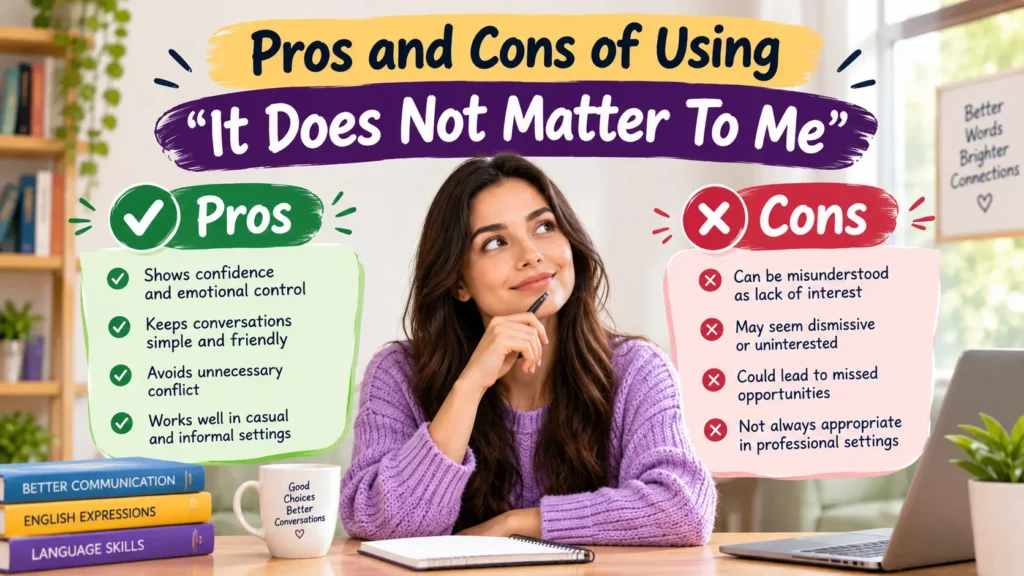
Advantages
- Clarity: The listener understands that you have no strong preference.
- Efficiency: It communicates the basic idea quickly.
- Accessibility: ESL learners and general audiences can easily understand it.
- Flexibility: It works in many everyday situations.
- Directness: The speaker does not hide their lack of preference.
Potential Drawbacks
- Oversimplification: It may hide useful details about what you actually prefer.
- Tone mismatch: It can sound colder than intended.
- Repetition: Frequent use can make communication feel flat.
- Possible ambiguity: It may mean “I am flexible” or “I do not care.”
- Emotional risk: In sensitive conversations, it can unintentionally hurt someone’s feelings.
Real-Life Examples of “It Does Not Matter To Me” by Context
Emails
“Thanks for checking. It does not matter to me whether we send the draft this afternoon or tomorrow morning, as long as the final figures are included.”
Here, the phrase clearly communicates flexibility while identifying what actually matters.
Meetings
“We can start with the budget or the timeline. It does not matter to me which one we discuss first.”
This is useful when the order of discussion has no meaningful effect.
Presentations
“You can use either version of the chart. It does not matter to me which format you choose.”
The speaker gives the other person freedom to decide.
Conversations
“Do you want to sit inside or outside?”
“It does not matter to me. You choose.”
The phrase communicates a lack of preference.
Social media
“People can disagree about which phone is better. It does not matter to me; I care more about whether the phone works reliably.”
Here, the phrase shifts attention away from a minor preference toward a more important issue.
“It Does Not Matter To Me” vs Similar Expressions (Key Differences)
| Phrase | Meaning Difference | Tone Difference | Best Use Scenario |
| I don’t mind | You are comfortable with the available option | Casual, relaxed | Everyday decisions |
| I have no preference | You have no particular choice you favor | Professional, neutral | Work and formal communication |
| I’m flexible | You can adapt to different options | Cooperative, positive | Scheduling and planning |
| Either is fine | Both presented choices are acceptable | Friendly, neutral | Choosing between two options |
| It makes no difference to me | The outcome has equal significance to you | Direct, slightly formal | Decisions where outcomes are equivalent |
| It’s up to you | You are giving the decision to another person | Neutral to casual | Shared decisions |
The central distinction is what exactly you are communicating. “I have no preference” focuses on choice. “I’m flexible” emphasizes adaptability. “It’s up to you” transfers the decision. “It makes no difference to me” emphasizes equal importance.
Common Mistakes & Misuse of “It Does Not Matter To Me”
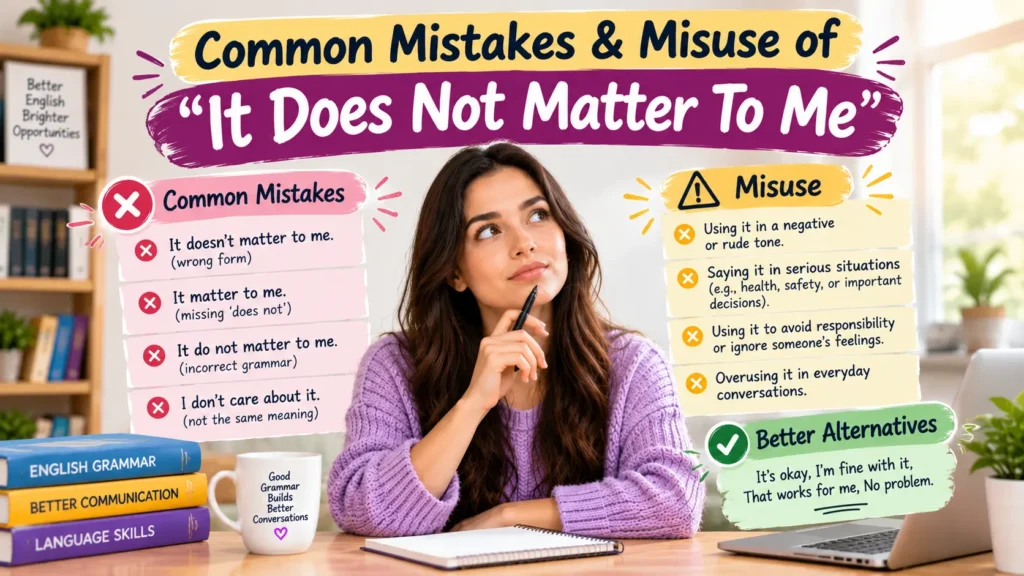
Overuse
Using the phrase for every decision can make you appear disengaged.
Instead of repeatedly saying:
“It does not matter to me.”
Vary your language:
“Either works.”
“I’m flexible.”
“I have no preference.”
Incorrect context
Do not use the phrase when you actually have an important preference.
If you strongly prefer Tuesday, saying “It does not matter to me” creates misleading communication.
Contradictory usage
Avoid saying the phrase and immediately giving a strong preference:
“It does not matter to me, but I definitely think we should choose option A.”
This sounds contradictory. Say:
“I’m open to either, although I slightly prefer option A.”
Cultural misunderstandings
ESL learners should remember that literal meaning is not always the whole message. In some contexts, “It does not matter to me” can sound more emotionally distant than “I don’t mind.”
“It Does Not Matter To Me” in Digital & Modern Communication
Emails
In professional email, clarity is more important than simply being brief. Consider:
“It does not matter to me which version you send.”
A warmer option could be:
“Either version works for me.”
Slack / WhatsApp
Digital messaging encourages shorter forms:
“Either works for me 👍”
or:
“No preference—your call.”
These usually feel more conversational than the full phrase.
Social media
The expression can be used to emphasize personal indifference:
“Everyone has a favorite, but it does not matter to me. I use whichever one gets the job done.”
AI-generated summaries
In summaries and rewritten communication, the phrase should be interpreted carefully. An AI system or writer should distinguish between lack of preference and lack of concern rather than automatically replacing the phrase with “I don’t care.”
Meaning, Usage & Examples for Each Alternative
I Have No Preference
Meaning: “I Have No Preference” means that you do not favor one available choice over another. It is particularly useful when several options are acceptable.
Why This Phrase Works: It removes ambiguity and focuses specifically on personal preference rather than suggesting that the entire subject is unimportant.
Real-World Usage Insight: This is one of the safest replacements for professional communication because it sounds calm and precise.
Best Use: Meetings, scheduling, surveys, workplace emails, academic discussions, and decision-making.
Avoid When: You actually have a preference that needs to be communicated.
Tone: Professional, neutral, clear.
US vs UK Usage: Common and natural in both American and British English.
Example (Email / Message / Meeting): “I have no preference between the two meeting rooms, so please book whichever one is available.”
I’m Flexible
Meaning: “I’m Flexible” means you can adapt to different choices, times, arrangements, or plans.
Why This Phrase Works: It communicates cooperation rather than simple indifference.
Real-World Usage Insight: This is especially effective when discussing schedules because it tells others they do not need to organize everything around you.
Best Use: Work schedules, appointments, travel plans, project meetings, and group arrangements.
Avoid When: You need a firm decision or have strict limitations.
Tone: Cooperative, positive, professional.
US vs UK Usage: Very common in both varieties of English.
Example (Email / Message / Meeting): “I’m flexible next week, so feel free to schedule the interview for any afternoon that suits the team.”
I Don’t Mind
Meaning: “I Don’t Mind” means that you are not bothered by the available choice or situation.
Why This Phrase Works: It is short, natural, and widely understood in everyday conversation.
Real-World Usage Insight: It often sounds warmer and more conversational than “It Does Not Matter To Me.”
Best Use: Informal conversations, everyday decisions, and casual workplace interactions.
Avoid When: You need to sound highly formal or make your position especially precise.
Tone: Casual, relaxed, friendly.
US vs UK Usage: Used in both, with particularly strong everyday familiarity in British English.
Example (Email / Message / Meeting): “I don’t mind which café we use. The one near the station is fine if that’s easier.”
Either Is Fine
Meaning: “Either Is Fine” means that two presented options are both acceptable.
Why This Phrase Works: It directly reassures the other person that they can choose between the options.
Real-World Usage Insight: It is often more positive than simply saying that something does not matter.
Best Use: Choosing times, restaurants, meeting rooms, travel arrangements, or two versions of a document.
Avoid When: More than two choices are being discussed unless the context clearly explains the options.
Tone: Friendly, neutral, accommodating.
US vs UK Usage: Natural in both American and British English.
Example (Email / Message / Meeting): “Either is fine. We can review the proposal before lunch or first thing tomorrow.”
It Makes No Difference To Me
Meaning: “It Makes No Difference To Me” means that the possible outcomes are equally acceptable or equally unimportant from the speaker’s perspective.
Why This Phrase Works: It is clear and slightly more formal than many casual alternatives.
Real-World Usage Insight: It works well when the speaker wants to emphasize that both outcomes have essentially the same effect.
Best Use: Professional conversations, planning, decisions, and formal-ish everyday communication.
Avoid When: Discussing someone’s emotions or a sensitive personal issue.
Tone: Neutral, direct, slightly formal.
US vs UK Usage: Common in both varieties.
Example (Email / Message / Meeting): “It makes no difference to me whether we publish the update today or tomorrow.”
I’m Open to Either Option
Meaning: “I’m Open to Either Option” means that you are willing to consider or accept either choice.
Why This Phrase Works: It communicates flexibility while leaving room for discussion.
Real-World Usage Insight: This wording is particularly useful when you want to participate in a decision without pushing a specific preference.
Best Use: Team discussions, negotiations, project planning, and professional emails.
Avoid When: You need to make a firm recommendation.
Tone: Professional, collaborative, constructive.
US vs UK Usage: Natural and widely understood in both.
Example (Email / Message / Meeting): “I’m open to either option, but I’d be happy to review the cost estimates before we decide.”
I’m Happy With Either Option
Meaning: “I’m Happy With Either Option” says that both choices are acceptable and that you are satisfied with either outcome.
Why This Phrase Works: The word “happy” adds a positive emotional signal that “It Does Not Matter To Me” may lack.
Real-World Usage Insight: It is useful when you want to reassure someone that they are not creating a problem by choosing one option.
Best Use: Collaborative decisions, scheduling, social plans, and friendly workplace communication.
Avoid When: You actually need to express concern or a preference.
Tone: Warm, positive, cooperative.
US vs UK Usage: Common in both American and British English.
Example (Email / Message / Meeting): “I’m happy with either option for the presentation, so go with the layout you think will be clearest.”
It’s Up to You
Meaning: “It’s Up to You” means that the other person can make the final decision.
Why This Phrase Works: It clearly transfers decision-making responsibility without requiring the speaker to choose.
Real-World Usage Insight: It can be helpful, but it may occasionally sound like the speaker is unwilling to participate.
Best Use: Casual planning, low-stakes decisions, and situations where another person has better information.
Avoid When: A colleague expects your professional recommendation or a decision requires shared responsibility.
Tone: Casual, neutral, sometimes detached.
US vs UK Usage: Very common in both varieties.
Example (Email / Message / Meeting): “It’s up to you which design we use. You’ve worked with the client longer, so I trust your judgment.”
Whatever Works
Meaning: “Whatever Works” means that any practical option is acceptable as long as it achieves the intended result.
Why This Phrase Works: It focuses on the outcome rather than the exact method.
Real-World Usage Insight: It is especially natural in quick conversations where everyone already understands the basic choices.
Best Use: Informal workplace chats, household decisions, errands, and casual planning.
Avoid When: You need polished formal communication or need to show detailed involvement.
Tone: Casual, efficient, sometimes blunt.
US vs UK Usage: Common in both American and British English.
Example (Email / Message / Meeting): “Whatever works for you is fine. I can join the call from home if that makes scheduling easier.”
Your Call
Meaning: “Your Call” means that the other person should make the decision.
Why This Phrase Works: It is extremely concise and clearly gives another person control over a choice.
Real-World Usage Insight: The expression is natural among coworkers and friends but is more informal than “I have no preference.”
Best Use: Casual conversations, quick messages, and familiar professional relationships.
Avoid When: Writing formal client emails or communicating with someone who may expect a recommendation.
Tone: Casual, confident, concise.
US vs UK Usage: Common in both, though familiarity may vary by speaker.
Example (Email / Message / Meeting): “Your call on the final slide. Both versions are accurate, so I’m comfortable using either.”
I’m Good With Either
Meaning: “I’m Good With Either” means that both available options are acceptable to you.
Why This Phrase Works: It is friendly and conversational while still communicating a clear lack of preference.
Real-World Usage Insight: This phrase is especially common in informal American English and digital communication.
Best Use: Messages, casual workplace conversations, group planning, and everyday decisions.
Avoid When: Highly formal writing where “I have no preference” would be clearer.
Tone: Casual, friendly, relaxed.
US vs UK Usage: Very common in American English; understandable in British English, though other alternatives may sound more natural to some UK speakers.
Example (Email / Message / Meeting): “I’m good with either restaurant. Pick whichever one has a table available.”
I’m Comfortable Either Way
Meaning: “I’m Comfortable Either Way” means that you feel equally at ease with the possible choices or outcomes.
Why This Phrase Works: It emphasizes reassurance and personal comfort rather than indifference.
Real-World Usage Insight: This is useful when another person is worried that their preferred option might inconvenience you.
Best Use: Workplace coordination, social planning, sensitive discussions, and collaborative decisions.
Avoid When: You need to communicate that the subject genuinely has no importance at all.
Tone: Warm, reassuring, cooperative.
US vs UK Usage: Natural in both American and British English.
Example (Email / Message / Meeting): “I’m comfortable either way regarding the presentation date. I can make both Tuesday and Thursday.”
Comparison Table of 10 Best Alternatives
The best alternative depends on whether you want to emphasize neutrality, flexibility, cooperation, or decision-making freedom. The table below highlights ten practical choices and the situations where each one works best.
| Phrase | Meaning | Best Use | Worst Use | Tone | US vs UK Usage |
| I Have No Preference | No particular choice is favored | Professional decisions | Emotional discussions | Neutral, professional | Common in both |
| I’m Flexible | Able to adapt | Scheduling and planning | Firm decisions | Cooperative | Common in both |
| I Don’t Mind | The choice does not bother you | Casual conversation | Highly formal writing | Casual, relaxed | Common in both |
| Either Is Fine | Both options are acceptable | Choosing between two options | Complex decisions | Friendly, neutral | Common in both |
| It Makes No Difference To Me | Both outcomes have equal significance | Professional planning | Sensitive topics | Direct, neutral | Common in both |
| I’m Open to Either Option | Willing to accept either choice | Team discussions | When a firm recommendation is needed | Collaborative | Common in both |
| I’m Happy With Either Option | Both choices are positively acceptable | Group decisions | When one option is clearly unsuitable | Warm, positive | Common in both |
| It’s Up to You | The other person decides | Casual planning | Shared professional decisions | Casual | Common in both |
| Whatever Works | Any practical solution is acceptable | Quick conversations | Formal client communication | Casual, efficient | Common in both |
| I’m Comfortable Either Way | Both choices feel acceptable | Reassuring communication | When you need to state a strong preference | Warm, reassuring | Common in both |
Conclusion:
“It Does Not Matter To Me” is a simple and useful English phrase that expresses a lack of preference, concern, or personal importance. Its meaning is usually clear, but its tone can change significantly depending on context, relationship, and delivery. In everyday conversations, it can communicate flexibility about plans, choices, schedules, or other low-stakes decisions. In professional communication, however, alternatives such as “I have no preference,” “I’m flexible,” or “Either option works for me” can sound more cooperative and polished.
Understanding these differences is especially valuable for ESL learners, students, professionals, and content writers who want their English to sound natural and appropriate. The phrase is not inherently rude or unprofessional, but it can occasionally sound dismissive when used during sensitive conversations. Choosing the right alternative helps you communicate your actual intention more accurately. Ultimately, effective communication depends not only on what words mean, but also on how those words are perceived by the listener or reader.
FAQs:
[faq_accordion]What does “It Does Not Matter To Me” mean?
“It Does Not Matter To Me” means that something is not important enough for you to have a particular preference. It can also mean that you are comfortable with different choices or outcomes. For example, if someone asks whether you prefer Monday or Tuesday, saying this can indicate that either day is acceptable to you.
Is “It Does Not Matter To Me” grammatically correct?
Yes, “It Does Not Matter To Me” is grammatically correct. The phrase uses “does not” to negate the verb “matter,” while “to me” identifies whose perspective is being expressed. In casual speech, people commonly shorten it to “It doesn’t matter to me.” Both versions are correct, although the contracted form sounds more conversational.
Is “It Does Not Matter To Me” rude?
The phrase is not automatically rude, but its tone depends on context and delivery. When discussing a simple choice, it usually sounds neutral. However, saying it during an emotional or sensitive conversation may make you sound indifferent or dismissive. If you want to sound warmer, try “I’m fine with either,” “I’m flexible,” or “I don’t have a preference.”
What is a professional alternative to “It Does Not Matter To Me”?
A strong professional alternative is “I have no preference.” Other suitable choices include “I’m flexible,” “Either option works for me,” and “I’m open to either option.” These expressions clearly communicate flexibility without suggesting that the overall subject is unimportant. They are particularly useful in workplace emails, meetings, scheduling discussions, and professional correspondence.
What is a polite way to say “It Does Not Matter To Me”?
Polite alternatives include “I’m happy with either option,” “Either is fine with me,” “I’m comfortable either way,” and “I’m fine with whichever you prefer.” These phrases preserve the idea of having no strong preference while adding a more cooperative or reassuring tone. They are especially useful when communicating with colleagues, clients, friends, or unfamiliar people.
What is the difference between “It Does Not Matter To Me” and “I Don’t Mind”?
“It Does Not Matter To Me” can emphasize that something has little personal importance, while “I Don’t Mind” usually means that a choice does not bother or inconvenience you. “I Don’t Mind” often sounds more casual and conversational. For example, “I don’t mind which restaurant we visit” sounds relaxed, while “It does not matter to me” can sound more neutral.
Can I use “It Does Not Matter To Me” in a professional email?
Yes, you can use it in a professional email, particularly when discussing a low-stakes preference. However, alternatives may sound more collaborative. Instead of “It does not matter to me which day we meet,” you could write “Either day works for me” or “I’m flexible regarding the meeting date.” These options make your willingness to cooperate more explicit.
What are the best synonyms for “It Does Not Matter To Me”?
Useful alternatives include “I have no preference,” “I’m flexible,” “I don’t mind,” “Either is fine,” “It makes no difference to me,” “It’s up to you,” “Whatever works,” and “I’m happy with either option.” The best choice depends on whether you want to sound professional, casual, reassuring, cooperative, or completely neutral.
Is “It Does Not Matter To Me” common in American and British English?
Yes. “It Does Not Matter To Me” is understood and used in both American and British English. There is no major difference in its core meaning. However, speakers may prefer different alternatives depending on context and personal style. Expressions such as “I don’t mind,” “Either is fine,” and “I’m flexible” are also widely understood across both varieties.
What should I say instead of “It Does Not Matter To Me”?
Choose an alternative based on your intended tone. Use “I have no preference” for professional communication, “I’m flexible” to emphasize cooperation, “Either is fine” for friendly situations, and “It’s up to you” when you want another person to decide. If the subject is sensitive, explain your position more carefully rather than simply saying that it does not matter.
[/faq_accordion]